Artificial Intelligence is no longer one thing.
Over the last two years, the term “AI” has become a catch-all phrase covering everything from simple chatbots to fully autonomous systems capable of planning, reasoning, using tools, browsing the web, writing code, and carrying out multi-step tasks with little human supervision.
That difference matters.
A business using AI merely to summarize emails is operating in a completely different world from a business deploying AI agents that can analyze customer requests, coordinate workflows, trigger actions across systems, and continuously improve outcomes.
The industry is now separating AI into two broad categories:
- Non-Agentic AI
- Agentic AI
Understanding the distinction between these two models is becoming critical for business leaders, software developers, marketers, and operations teams.
This article explains:
- What non-agentic AI is
- What agentic AI is
- Key differences between them
- Real-world examples
- Risks and limitations
- Business applications
- Why agentic AI is becoming the next major shift in enterprise software
What Is Non-Agentic AI?
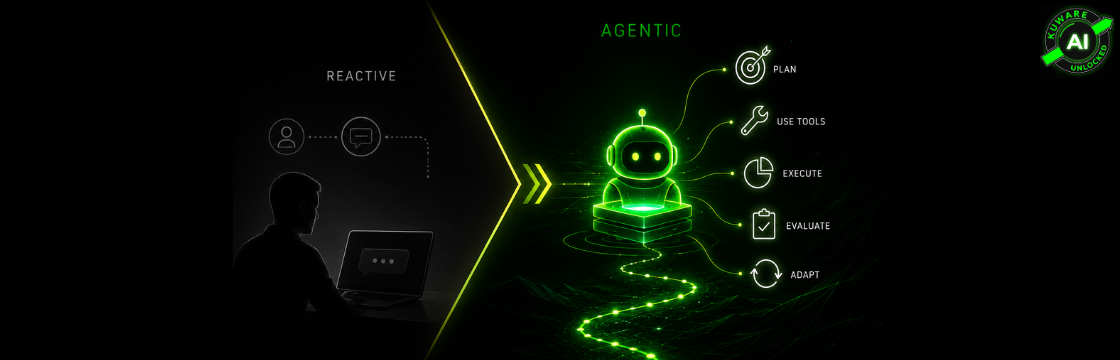
Non-agentic AI refers to AI systems that respond to a single request without independently planning, remembering, or taking initiative.
These systems are reactive.
You ask. They answer. The interaction ends.
Most people interacting with AI today are primarily using non-agentic systems.
Examples include:
- Basic ChatGPT conversations
- AI summarizers
- Image generators
- Grammar correction tools
- Single-prompt coding assistants
- FAQ chatbots
- Translation systems
These systems are powerful, but they are generally confined to:
- One prompt
- One response
- Limited context
- No independent action
Characteristics of Non-Agentic AI
1. Reactive Instead of Proactive
The AI waits for instructions.
It does not independently decide what to do next.
If a user says:
“Write me a blog post about plumbing marketing.”
The AI writes the blog.
But it does not:
- Research competitors
- Publish the article
- Create social posts
- Schedule distribution
- Analyze performance later
unless explicitly instructed step-by-step.
2. Minimal Memory
Most non-agentic systems have limited or no persistent memory.
Once the session ends, the AI often “forgets” the interaction.
Even when memory exists, it is usually shallow compared to true long-term task continuity.
3. No Autonomous Goal Execution
Non-agentic AI does not create plans to achieve broader objectives.
It simply executes the immediate request.
4. Limited Tool Usage
Traditional non-agentic systems may not:
- Access external software
- Use APIs autonomously
- Browse the web strategically
- Trigger workflows
- Operate across systems
They primarily generate content or responses.
What Is Agentic AI?
Agentic AI refers to AI systems capable of pursuing goals autonomously through planning, reasoning, memory, tool usage, and iterative decision-making.
Instead of simply answering a prompt, agentic systems behave more like digital workers or assistants.
They can:
- Break large tasks into smaller tasks
- Decide what steps are needed
- Use tools and APIs
- Retrieve information
- Analyze outcomes
- Adapt strategies
- Continue working toward objectives
Agentic AI introduces initiative.
This is the key difference.
What Makes Agentic AI Different?
One of the biggest reasons this topic has exploded recently is because the AI industry itself is still debating where the line actually exists between automation and true agency.
A lot of software marketed today as “agentic AI” may actually be:
- advanced automation
- tool-calling workflows
- scripted orchestration
- state machines with LLM outputs
- reactive systems with memory
This has even led to a phrase increasingly used in the AI community:
Agent Washing
Agent washing refers to rebranding ordinary automation or chatbot systems as “AI agents” for marketing purposes.
For example:
- a chatbot connected to a CRM
- a workflow using Zapier
- a fixed sequence of API calls
- an LLM following predefined steps
may look intelligent and dynamic while still operating inside tightly scripted boundaries.
The distinction becomes important because true agentic systems can:
- adapt to unexpected situations
- recover from failures
- change strategies
- operate in ambiguous environments
- pursue goals without predefined instructions
That level of adaptability is still relatively rare.
FAQ: What Is a Good Test for True Agentic AI?
A useful practical test is this:
Give the AI a genuinely new goal with no predefined steps and walk away.
If the system can:
- break the problem into tasks
- determine what tools it needs
- try different approaches
- recover from failure
- replan when things go wrong
- complete the task independently
then the system is operating with meaningful agency.
If instead it:
- constantly asks for clarification
- fails after the first obstacle
- only follows rigid workflows
- cannot adapt beyond predefined paths
then it is likely automation with AI components rather than truly agentic behavior.
FAQ: What Does It Take to Build a Truly Agentic System?
Building truly agentic systems is significantly harder than building chatbots.
At minimum, four major components are usually required:
1. Goals Instead of Fixed Instructions
Traditional automation follows predefined instructions.
Agentic systems operate from objectives.
Instead of:
“Run these exact five steps.”
an agentic system may receive:
“Increase appointment bookings for this business.”
The AI must determine how to achieve the outcome.
2. Planning and Reasoning
The system needs the ability to:
- decompose tasks
- sequence actions
- evaluate dependencies
- prioritize decisions
- reason through uncertainty
This planning layer is one of the key differences between simple automation and agents.
3. Memory and Tool Access
Agentic systems usually require:
- short-term working memory
- long-term memory
- retrieval systems
- external tools
- APIs
- databases
- software integrations
Without memory and tools, an agent cannot sustain long-running tasks.
4. Recovery and Adaptation
Real-world environments are messy.
Things fail.
Websites change.
APIs break.
Credentials expire.
Tasks produce unexpected outputs.
A truly agentic system must be able to:
- detect problems
- retry intelligently
- switch strategies
- escalate when needed
- continue operating despite failure
The simplest mental model is:
Observe → Plan → Act → Evaluate → Repeat
That looping behavior is central to many modern AI agents.
What Makes Agentic AI Different?
1. Goal-Oriented Behavior
Instead of reacting to a single prompt, agentic AI works toward a broader outcome.
Example:
A non-agentic AI may answer:
“What are good SEO keywords for plumbers?”
An agentic AI system may:
- Analyze local competitors
- Research search volume
- Generate keyword clusters
- Build landing page outlines
- Create ad copy
- Schedule publishing
- Monitor ranking changes
- Recommend optimizations weekly
The difference is enormous.
2. Planning and Multi-Step Reasoning
Agentic systems can create execution plans.
Instead of needing every step explicitly defined, the AI can determine:
- What should happen first
- Which tools are needed
- What dependencies exist
- What information is missing
- Whether the result achieved the objective
This begins to resemble human workflow execution.
3. Tool Usage
One of the biggest breakthroughs in modern AI systems is tool integration.
Agentic AI can:
- Call APIs
- Read spreadsheets
- Search databases
- Browse websites
- Execute code
- Trigger automations
- Update CRMs
- Schedule meetings
- Send emails
- Analyze analytics dashboards
This transforms AI from “content generation” into operational execution.
4. Memory and Context Retention
Agentic systems often maintain persistent memory.
This allows them to:
- Remember previous interactions
- Learn user preferences
- Store project context
- Continue long-running workflows
- Avoid repeating work
For example, an AI sales assistant could remember:
- Which leads responded
- Which offers worked
- Customer objections
- Previous conversations
- Follow-up schedules
This creates continuity.
5. Iteration and Self-Correction
Agentic AI systems can evaluate their own outputs and improve them.
Example:
An AI coding agent may:
- Write code
- Run tests
- Detect failures
- Debug issues
- Rewrite portions
- Test again
without needing repeated human intervention.
This iterative loop is a major step beyond static prompt-response systems.
FAQ: Is ChatGPT Agentic or Non-Agentic?
The answer depends on how it is being used.
Basic ChatGPT usage is typically non-agentic.
However, when combined with:
- memory
- tools
- APIs
- workflows
- browsing
- automation systems
- external software
it can become part of an agentic architecture.
Modern AI platforms are increasingly adding agentic capabilities.
This includes:
- AI coding agents
- AI research agents
- AI customer support systems
- AI sales assistants
- AI workflow orchestrators
The line between the two categories is rapidly blurring.
Real-World Examples of Non-Agentic AI
Customer Support FAQ Bot
A simple support bot that answers pre-trained questions is non-agentic.
It responds only when asked.
It cannot independently:
- escalate tickets
- investigate systems
- track customer history
- coordinate across departments
AI Writing Assistant
An AI blog writer generating one article from one prompt is non-agentic.
It creates content but does not manage the full publishing lifecycle.
AI Image Generator
Tools generating images from prompts are generally non-agentic.
They produce outputs but do not independently pursue objectives.
Real-World Examples of Agentic AI
OpenClaw
Projects like OpenClaw are strong real-world examples of agentic architectures.
These systems can:
- run locally
- interact through messaging platforms
- access tools
- manage workflows
- execute commands
- operate proactively in the background
Instead of waiting for every individual prompt, they maintain operational loops and ongoing context.
OpenHands and Devin
AI coding agents such as OpenHands and Devin demonstrate some of the clearest examples of modern agentic workflows.
These systems can:
- inspect unfamiliar codebases
- determine required changes
- edit files
- run tests
- debug failures
- retry solutions
- iterate until objectives are satisfied
The important distinction is that the exact actions are not predefined.
The system dynamically adapts based on outcomes.
Multi-Agent Research Systems
Some advanced systems now use teams of collaborating agents.
One agent may:
- research information
Another may:
- critique outputs
Another may:
- refine recommendations
Another may:
- generate reports
These collaborative architectures are becoming increasingly common in enterprise AI experimentation.
The Gray Area: When Is AI Actually Agentic?
One of the most debated topics in AI today is the gray area between automation and agency.
Some systems feel agentic without actually being highly autonomous.
Others operate inside structured boundaries while still demonstrating meaningful reasoning.
This is where many philosophical debates inside the AI community now exist.
LangGraph and Structured Agency
Frameworks like LangGraph are a good example.
LangGraph allows developers to build structured flows or state machines.
Inside each node, an LLM may make decisions dynamically.
However, the AI usually cannot invent completely new workflow stages outside the graph structure defined by developers.
This raises a major debate:
Is this truly agentic?
Or is it simply structured automation with intelligent decision-making inside predefined boundaries?
Reasonable experts disagree.
Some consider it:
- smart orchestration
- guided agency
- constrained agents
Others argue:
- true agency requires open-ended autonomy
- predefined graphs limit real independence
This debate is still evolving.
Zapier AI and Similar Systems
Many automation platforms now market “AI agents.”
In reality, many of these systems:
- follow predefined flows
- call APIs conditionally
- use LLMs for classification
- operate inside rigid boundaries
They may appear intelligent while still lacking:
- adaptive reasoning
- long-term planning
- autonomous recovery
- open-ended decision-making
This does not make them useless.
They can still create enormous business value.
But technically, they may sit closer to automation than true agency.
FAQ: Is Automation the Same as Agentic AI?
No.
Automation and agency are related but fundamentally different.
Automation usually means:
- fixed workflows
- predefined logic
- deterministic actions
- scripted behavior
Agentic AI introduces:
- dynamic decision-making
- adaptability
- reasoning
- autonomous problem solving
- changing execution paths
Example:
A workflow that always follows the same five steps is automation.
A system that changes its strategy depending on conditions is closer to agentic behavior.
Agentic Spectrum: From Low Agency to High Agency
Not all AI systems are equally agentic.
It is often more useful to think of AI on a spectrum.
Low Agency
- Tool calling
- Prompt chaining
- ReAct loops
- Simple automations
- Retrieval workflows
These systems can appear intelligent but remain highly constrained.
Medium Agency
- Planning agents
- Multi-step workflows
- Memory-enabled assistants
- Structured orchestration systems
- LangGraph-style state systems
These systems can adapt within boundaries.
High Agency
- Autonomous agents
- Multi-agent collaboration systems
- Self-correcting research agents
- Autonomous coding systems
- Long-running operational agents
These systems can operate independently toward goals for extended periods.
Related Terms and Glossary
LLM Agents
AI systems powered by large language models combined with tools, memory, and workflows.
Autonomous Agents
Agents capable of operating with minimal supervision.
Multi-Agent Systems
Groups of AI agents collaborating together.
ReAct
A popular framework combining reasoning and action in iterative loops.
Tool Calling
The ability for AI systems to invoke external software or APIs.
Agent Loop
The repeating cycle of:
Observe → Plan → Act → Evaluate
Orchestrator
A coordinating layer managing multiple agents or workflows.
Planner
AI systems powered by large language models combined with tools, memory, and workflows.
Reflector
An evaluation component that critiques outputs and improves quality.
Swarm Intelligence
Large groups of agents coordinating collectively to solve problems.
Cognitive Architecture
The broader design structure governing how an intelligent system thinks, remembers, reasons, and acts.
Real-World Examples of Non-Agentic AI
An AI SDR system may:
An AI SDR system may:
- identify leads
- enrich contact information
- personalize outreach
- send emails
- track responses
- schedule follow-ups
- update CRM systems
- optimize messaging over time
This is agentic behavior.
AI Coding Agent
Modern coding agents can:
- analyze repositories
- edit multiple files
- run tests
- debug issues
- create pull requests
- deploy updates
with limited supervision.
AI Marketing Workflow Agent
A marketing-focused AI agent may:
- analyze competitors
- generate SEO strategies
- write landing pages
- create ads
- monitor analytics
- recommend campaign adjustments
- produce weekly summaries
This moves AI from assistant to operator.
Why Agentic AI Matters for Businesses
Agentic AI changes the economics of labor.
Traditional software requires humans to:
- interpret data
- decide actions
- coordinate workflows
- move information between systems
Agentic systems begin automating portions of that decision-making layer.
This can dramatically improve:
- operational efficiency
- customer response speed
- scalability
- consistency
- workflow execution
Businesses increasingly view AI not merely as a tool, but as a workforce multiplier.
FAQ: Will Agentic AI Replace Employees?
Not entirely.
At least not in the near term.
Agentic AI is better viewed as:
- digital augmentation
- workflow acceleration
- operational automation
- intelligent assistance
The businesses seeing the best results are combining:
- human judgment
- AI execution
- automation systems
- oversight and validation
In many cases, AI reduces repetitive work while humans focus on:
- strategy
- creativity
- relationship building
- high-level decision-making
Risks of Agentic AI
Agentic systems are powerful, but they introduce significant risks.
1. Autonomous Mistakes
An agent capable of acting independently can also make independent mistakes.
This may include:
- sending incorrect emails
- modifying systems improperly
- executing flawed workflows
- making bad recommendations
Human oversight remains important.
2. Security Risks
Agentic AI often requires:
- API access
- database permissions
- CRM integration
- cloud credentials
- customer information access
Poor security design can create major vulnerabilities.
3. Hallucinations at Scale
Traditional hallucinations are annoying.
Agentic hallucinations can become operationally dangerous.
If an AI agent takes action based on incorrect assumptions, the impact can multiply quickly.
4. Runaway Automation
Without safeguards, agentic systems may:
- over-execute tasks
- trigger loops
- generate excessive API costs
- create unwanted changes
Guardrails are essential.
An AI agent is typically a software system combining:
- An LLM (Large Language Model)
- Memory
- Tool access
- Planning logic
- Decision-making workflows
- Execution capabilities
Think of the LLM as the “brain.”
The surrounding systems give it the ability to act.
This is similar to how humans operate:
- memory stores knowledge
- tools extend capability
- planning enables execution
- feedback improves performance
FAQ: Are AI Agents the Same as Automation?
No.
Traditional automation follows fixed rules.
Example:
“If form submitted, send email.”
Agentic AI is dynamic.
It can decide:
- what action to take
- how to respond
- which tool to use
- whether a task succeeded
- what should happen next
This introduces adaptability.
The Future: Multi-Agent Systems
The industry is now moving beyond single agents.
Many advanced systems use multiple specialized agents working together.
For example:
- a research agent gathers information
- a planning agent creates strategy
- an execution agent performs tasks
- a review agent checks quality
- a reporting agent summarizes outcomes
This resembles organizational structures inside businesses.
Future enterprise systems may increasingly look like teams of AI workers collaborating across departments.
Agentic AI in Marketing
Marketing is one of the fastest-growing areas for agentic AI.
Potential applications include:
- autonomous SEO optimization
- AI ad campaign management
- content strategy generation
- competitor analysis
- lead nurturing
- customer segmentation
- AI-powered analytics interpretation
- reputation management
Instead of isolated tools, businesses are moving toward interconnected AI systems handling end-to-end workflows.
FAQ: Should Small Businesses Care About Agentic AI?
Absolutely.
Small businesses may benefit even more than enterprises because AI can help smaller teams operate with greater leverage.
A company with:
- 5 employees
- strong AI workflows
- automation systems
- intelligent agents
may outperform much larger competitors operating inefficiently.
This is one reason AI adoption is accelerating rapidly among small and mid-sized businesses.
The Human Shift: From Doing Work to Directing Work
One of the most important long-term changes may be the role humans play.
Historically:
Humans performed the tasks directly.
With AI assistants:
Humans collaborated with software.
With agentic AI:
Humans increasingly become:
- supervisors
- strategists
- validators
- orchestrators
The skill shifts from:
“doing everything manually”
to:
“designing systems that execute effectively.”
This is a major philosophical and operational transition.
Final Thoughts: Why This Shift Matters
The transition from non-agentic AI to agentic AI may become one of the most important shifts in modern software.
Non-agentic AI gave businesses intelligent responses.
Agentic AI introduces intelligent execution.
That changes everything.
Businesses that understand this transition early may gain enormous advantages in:
- efficiency
- scalability
- customer experience
- operational speed
- decision-making
- cost structure
At the same time, agentic AI requires:
- governance
- oversight
- security
- architecture planning
- human supervision
The future is unlikely to be fully autonomous AI replacing humans.
More realistically, the future will involve humans working alongside increasingly capable AI agents.
The organizations that learn how to design, supervise, and leverage these systems effectively may define the next generation of competitive advantage.
At Kuware, we closely track emerging AI architectures, workflows, and business applications to help companies move beyond hype and implement practical AI systems that create measurable operational value.
