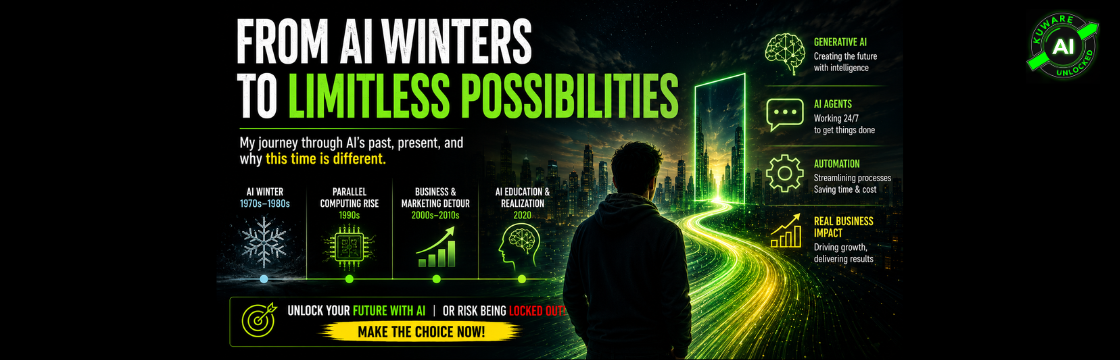
In 1989, I came to the United States to study computer engineering with one goal in mind: Artificial Intelligence.
Back then, AI was not trendy. There were no AI influencers, billion-dollar model launches, or everyday business owners talking about AI workflows. AI felt distant, experimental, and mostly academic.
And then the AI industry collapsed.
By the early 1990s, funding for AI research had dried up. Universities struggled to support AI programs, and funded PhD opportunities became incredibly difficult to secure. I had walked directly into the second AI winter.
So I pivoted.
Instead of pursuing AI directly, I moved into computer architecture and parallel computing. Looking back now, that detour became one of the most important foundations for understanding modern AI infrastructure.
During my graduate work at The University of Texas at Austin, I worked on hypercube topologies, interconnection schemes, and parallel architectures. At the time, it did not feel like AI work. Today, those same concepts sit underneath the infrastructure powering GPUs, distributed systems, and large-scale AI workloads.
My career eventually took me through Motorola, Intel, and years of work in microprocessor architecture and multithreading systems.
Later, I moved into marketing and business operations. Running agencies forced me to deeply understand how businesses actually function:
- Customer acquisition
- Operations
- Margins
- Hiring
- Lead generation
- Customer retention
That business understanding became one of my biggest advantages in AI.
Because AI by itself is not the solution.
Business problems are.
Today, one of the biggest misunderstandings in the market is that people treat all AI as one giant category. It is not.
Predictive AI answers:
“What is likely to happen?”
“What is likely to happen?”
Generative AI answers:
“Can you create something new for me?”
“Can you create something new for me?”
Predictive AI powers:
- Fraud detection
- Demand forecasting
- Customer churn prediction
- Risk scoring
- Predictive maintenance
Generative AI powers:
- AI chatbots
- Content generation
- Code generation
- Images and video
- AI agents
The most powerful systems increasingly combine both.
That hybrid approach is where AI becomes transformational rather than simply impressive.
What feels different today versus previous AI hype cycles is that infrastructure finally caught up. Cloud computing, GPUs, APIs, distributed systems, and massive datasets all converged at the same time.
For the first time, AI became practical and accessible for ordinary businesses at scale.
And after more than 35 years watching AI rise, collapse, disappear, and return, I believe we are still incredibly early in what comes next.
Companion Blog
Continue reading the companion article:
This companion piece breaks down predictive AI, hybrid AI systems, real-world business use cases, XGBoost models, and why predictive AI often creates faster measurable ROI than generative AI alone.
