Why the way you communicate with AI matters far more than whether AI is actually “thinking.”
You’ve probably heard this advice more than once:
“Don’t say please or thank you to ChatGPT. It’s a machine. It doesn’t care. You’re just wasting tokens.”
I used to believe that too.
Then I noticed something that completely changed how I work with AI every day.
The more I treat a large language model like a smart human colleague, the better the results become.
Not because the model has feelings.
Not because it’s conscious.
And definitely not because it appreciates good manners.
The real reason is much simpler.
When I naturally start talking to AI the same way I’d talk to a highly capable new employee, I end up giving it the information it actually needs to do great work.
That changes everything.
AI Doesn't Need Manners. You Do.
Let’s get one thing out of the way.
Large language models aren’t people. They aren’t secretly sitting inside your computer waiting to be offended because you forgot to say “please.”
But here’s what many people miss.
The communication habits we naturally use with smart people happen to be almost exactly the habits that produce better AI outputs.
That’s the interesting part.
The benefit isn’t changing the AI.
It’s changing how you communicate.
Humans and LLMs Are Both Prediction Machines
This is where things get surprisingly interesting.
Strip away all the hype, and both the human brain and a large language model are doing something remarkably similar.
If someone asks you:
“What’s 2 + 2?”
You don’t rebuild mathematics from scratch.
You don’t consciously derive the answer.
You simply know it.
Your brain has seen that pattern thousands of times, and the answer appears almost instantly.
LLMs work in a similar way, although at a vastly different scale.
They’ve compressed enormous amounts of human language into statistical patterns. Given the current context, they predict what sequence of words is most likely to come next.
Neither system is “thinking” from first principles every time a familiar problem appears.
Both are largely recognizing patterns they’ve already learned.
That also explains something people notice immediately.
Ask exactly the same question twice.
Sometimes you’ll get different answers.
Humans do this constantly.
Our mood changes.
Our recent conversations influence us.
What we read five minutes ago affects how we respond now.
LLMs work similarly, except their “working memory” is the conversation context you’ve given them.
Everything that came before shapes what comes next.
The Best Mental Model I've Found: A Brilliant New Hire
This is the framework that changed how I use AI.
Imagine you hire someone incredibly smart.
Maybe they have a PhD.
Maybe they’re one of the best writers you’ve ever met.
Maybe they’ve spent twenty years studying your industry.
Now imagine it’s their very first day.
They know almost nothing about:
- your company
- your customers
- your tone of voice
- your previous decisions
- your internal terminology
- what success looks like for this project
If you walk over and say,
“Write a blog post about AI.”
You’ll probably get something technically correct.
But it’ll also be generic.
Now imagine spending fifteen minutes explaining:
- who your audience is
- what you’ve already published
- what your company believes
- which ideas you’ve already rejected
- examples of writing you love
- the exact outcome you’re trying to achieve
The quality would improve dramatically.
AI works exactly the same way.
Most People Are Still Treating AI Like Google
This is probably the biggest mistake I see.
People open ChatGPT or Claude and type something like:
“Write me a blog about AI.”
Then they’re disappointed.
“It sounds generic.”
Of course it does.
The model had to invent almost everything.
It doesn’t know:
- your business
- your audience
- your opinions
- your writing style
- your experience
- your constraints
So it fills in all the missing information with the statistical average of the internet.
Average input.
Average assumptions.
Average output.
When you start treating AI like a new employee instead of a search engine, you naturally begin providing all the missing pieces.
The results improve because the information was finally available.
Your Knowledge Base Is Really an Operations Manual
People often describe knowledge bases as if they’re just document storage.
I don’t think that’s the right way to think about them.
Imagine hiring someone new.
On their first day you hand them:
- your operations manual
- company policies
- brand guidelines
- previous projects
- customer documentation
- internal playbooks
You’re telling them:
“Read this first. This is how we work.”
That’s exactly what a knowledge base does for AI.
Instead of forcing the model to guess your voice, your terminology, or the decisions you’ve already made, you’re giving it the same reference material a human employee would receive.
The AI becomes grounded in your reality instead of the internet’s average opinion.
That’s one of the biggest reasons Projects, custom GPTs, and enterprise knowledge bases produce such consistently better results.
Context Windows Feel Surprisingly Human
Even AI’s limitations remind me of working with people.
Humans forget details.
Not because they’re unintelligent.
Because attention has limits.
AI has something similar.
Every model has a context window.
Once conversations become very long, earlier parts eventually become less accessible or compressed.
I ran into this recently while creating a long series of related blog posts.
We started with a master list of topics.
Then we spent a long time refining the first article.
Then the second.
Then the third.
By the time we reached later posts, I noticed the model starting to repeat ideas from earlier discussions.
The fix was incredibly simple.
I asked it to summarize everything we’d already decided.
That summary brought the important decisions back into active context.
Suddenly the conversation was aligned again.
It’s exactly what you’d do with a colleague who’s been buried in a project for weeks.
You’d say:
“Let’s quickly recap where we are before we continue.”
Humans need that.
AI benefits from it too.
Why Saying "Please" Can Actually Improve Results
This is the part that surprises people.
No, ChatGPT doesn’t become happier because you thanked it.
It doesn’t feel respected.
But you behave differently.
When you interact with AI like a person instead of a vending machine, you naturally begin to:
- explain your goals more clearly
- provide missing context
- clarify assumptions
- think through your own request before asking it
- communicate more completely
Those tiny social habits create better communication habits.
And better communication almost always produces better output.
The improvement isn’t coming from politeness itself.
It’s coming from the richer context that polite, conversational communication tends to include.
Practical Rules That Actually Work
After thousands of hours working with modern LLMs, these habits consistently produce better results.
1. Treat every new conversation like day one for a brilliant new hire.
Never assume the model knows your business, your audience, or your previous work.
2. Give the same background you'd give a capable colleague.
Explain the goal.
Describe the audience.
Share the constraints.
Show examples whenever possible.
3. Think of your knowledge base as the company handbook.
It’s not optional reference material.
It’s the operations manual that teaches AI how your organization works.
4. In long conversations, periodically summarize the important decisions.
This refreshes the active context and helps prevent repetition or drift.
5. Talk naturally.
You don’t need magical prompt formulas for every interaction.
Clear, conversational communication usually contains the information the model needs.
The Goal Was Never to Pretend AI Is Human
This isn’t about anthropomorphizing machines.
It’s not about believing AI is conscious.
It’s about recognizing something practical.
The communication patterns we’ve developed over thousands of years for working with capable humans happen to work remarkably well with today’s AI systems.
Because in both cases, context matters.
Expectations matter.
Shared understanding matters.
The more information you provide, the less guessing has to happen.
And less guessing almost always leads to better work.
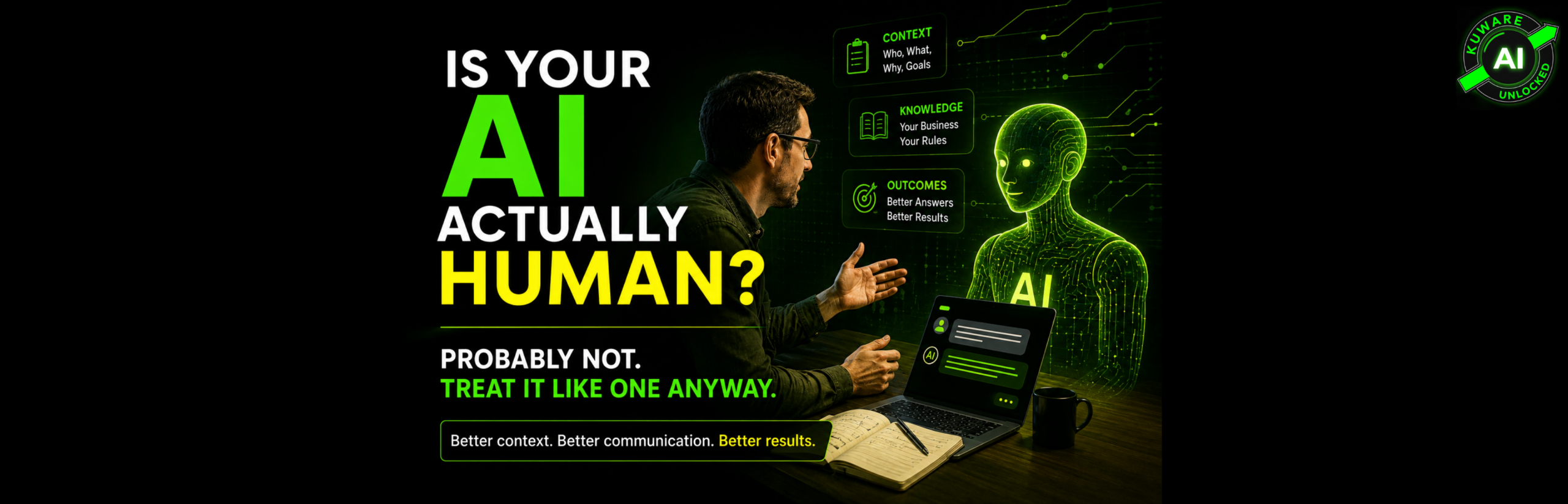
So no, your AI probably isn’t human.
But if you treat every new conversation like you’re onboarding an exceptionally bright new team member, you’ll almost certainly get better results.
I’ve found that’s one of the simplest productivity improvements anyone can make with AI today.
Treat it like a brilliant new hire on day one.
You might be surprised how much better the work becomes.
