
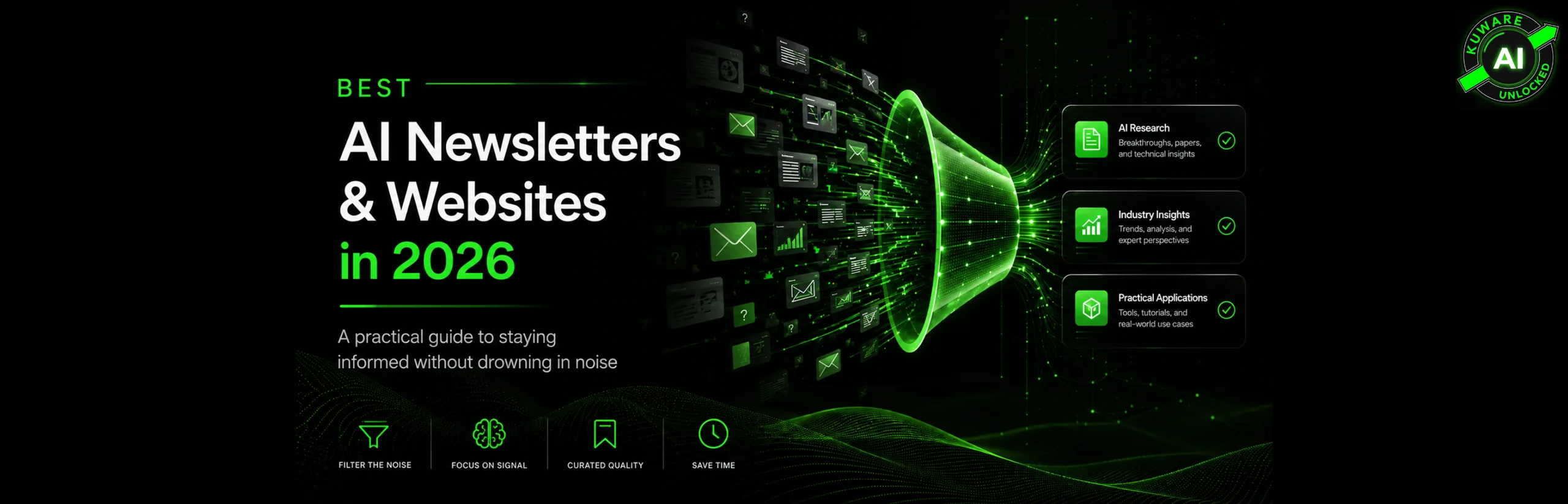
Last year, I thought the answer to AI information overload was a better list.
I was wrong.
By 2026, finding AI news isn’t the problem. The same announcement gets rewritten 30 times before breakfast.
A model company publishes a release. Then every newsletter summarizes it. LinkedIn fills up with hot takes. YouTube thumbnails declare that everything has changed. And within a few hours, people who haven’t used the model are explaining exactly how it will transform your business.
That isn’t staying informed.
That’s subscribing to duplication.
The real challenge is building a small group of sources that do different jobs:
- One source tells you what happened.
- Another explains why it matters.
- A specialist helps you understand the technical or business implications.
- A primary or independent source helps you verify the claims.
That’s the system we use while producing Kuware’s weekly Signal > Noise newsletter. We don’t try to cover every model, benchmark, funding announcement, and AI tool. We focus on developments that could affect how companies operate, market, build, hire, or invest.
Here are the AI newsletters and websites that consistently earn our attention in 2026.
The Best Daily AI Newsletters
Daily newsletters are useful for orientation. They tell you what happened while you were working, sleeping, or trying to avoid LinkedIn.
But you only need one.
Reading four daily AI newsletters usually means reading the same five stories four different ways.
The Rundown AI
Best for: Founders, operators, marketers, and general business readers
The Rundown AI remains one of the strongest all-around daily AI newsletters.
It combines major news, new tools, practical examples, and short tutorials in a format you can scan quickly. It’s broad enough for nontechnical readers but still useful for people actively implementing AI.
The downside is the same thing that makes it useful: breadth. It covers a lot, which means it can’t go particularly deep. You’ll also see sponsored products mixed into the flow, so don’t treat every featured tool as an independent recommendation.
Use The Rundown to know what happened. Go elsewhere to decide what it means.
TLDR AI
Best for: Developers, technical founders, and people who hate filler
TLDR AI is probably the cleanest technical daily scan.
It covers model releases, research papers, developer tools, open-source projects, and industry news without turning every item into a dramatic prediction. The newsletter is published on weekdays and is designed to be read in roughly five minutes.
It’s concise to the point of being dry.
That’s not a criticism. It’s the product.
TLDR AI gives you enough information to identify what deserves a closer look without pretending a three-paragraph summary replaces the original source.
Superhuman AI
Best for: Busy professionals who want the fastest possible overview
Superhuman AI focuses on short, accessible updates with a strong productivity angle.
Most issues combine important news, usable prompts, workflow ideas, and tool recommendations. The tone is light, and the newsletter is designed to be consumed in around three minutes.
It’s a good fit for executives and professionals who want to know what’s changing without getting dragged into model architecture or benchmark methodology.
The trade-off is depth. Superhuman is a starting point, not a research source.
The Neuron
Best for: Beginners and readers who prefer personality over technical density
The Neuron makes AI news approachable.
Its writers use humor, analogies, visual explanations, and a casual voice to break down developments that might otherwise feel intimidating. It also covers tools and practical use cases rather than concentrating entirely on research.
The Neuron is especially useful when you’re introducing colleagues or clients to AI and don’t want their first experience to feel like a graduate seminar.
Its lighter tone won’t work for everyone, but it is one of the more readable daily newsletters in the category.
The Best Weekly AI Newsletters for Context
Daily newsletters answer, “What happened?”
The best weekly newsletters answer the harder question:
Why should I care?
This is where the real value usually lives.
The Batch
Best for: Clear, balanced explanations of important AI developments
The Batch from DeepLearning.AI remains one of the most dependable weekly AI publications.
It covers research, industry moves, applications, and policy without treating every release as a revolution. The explanations are technical enough to be useful but accessible enough for executives and general business readers.
This is one of the first newsletters I recommend to someone who wants to understand AI rather than merely collect headlines.
It won’t make you the first person to hear about a launch. It may help you become one of the few people who understands what the launch actually changes.
One Useful Thing
Best for: Business leaders, educators, consultants, and people applying AI at work
One Useful Thing by Ethan Mollick is not really an AI news digest.
That’s exactly why it belongs here.
Mollick runs experiments, examines research, and explores what AI means for knowledge work, education, management, and organizational design. He spends less time repeating announcements and more time asking what humans and companies should do differently.
You may not agree with every conclusion. I don’t think you’re supposed to.
The value is that the newsletter gives you a framework for thinking about AI adoption instead of another pile of product updates.
Import AI
Best for: Researchers, policy professionals, investors, and serious AI observers
Import AI by Jack Clark has been around long enough to have perspective.
It focuses on research, compute, geopolitics, safety, national policy, and the strategic direction of the AI industry. Issues can be dense, but they frequently connect developments that fast news sources cover separately.
Import AI also has a clear point of view. Read it as informed analysis, not neutral stenography.
For readers trying to understand where frontier AI is heading and how governments or major labs may respond, it remains one of the most valuable publications available.
Last Week in AI
Best for: People who want one comprehensive weekly catch-up
Last Week in AI is useful when you don’t want to monitor daily newsletters at all.
It publishes written and audio recaps covering important research, company announcements, policy developments, and industry debates. Its editorial sections help separate meaningful stories from routine product noise.
The newsletter can be longer than the others on this list, and its production schedule has occasionally varied. But if you want one substantial weekly overview, it’s a solid choice.
The Algorithm
Best for: Reported analysis of AI science, business, and social impact
MIT Technology Review’s AI newsletter, The Algorithm, brings something many newsletters lack: actual journalism.
It looks beyond product announcements to examine research quality, labor implications, policy, safety, and the people or organizations shaping the field.
Because it comes from a newsroom rather than a tool-discovery business, it is less likely to spend an entire issue on whichever AI app happens to be trending that morning.
That makes it a useful counterweight to the daily hype cycle.
Exponential View
Best for: Executives and investors thinking beyond the current product cycle
Exponential View by Azeem Azhar covers AI alongside energy, economics, biotechnology, geopolitics, and other technologies shaping the next several years.
It is broader than an AI newsletter, but that breadth is the point.
AI doesn’t operate in isolation. It affects labor, capital investment, national competition, infrastructure, and company strategy. Exponential View helps connect those dots.
Some content is reserved for paying subscribers, so it may not be the first newsletter you add. But it is one of the better sources for long-range strategic thinking.
The Best AI Newsletters for Builders and Technical Readers
Most general newsletters tell you that a new model launched.
The sources in this section help you understand how it was built, how it performs, and whether it changes anything for people shipping real systems.
Ahead of AI
Best for: Machine learning engineers and technically serious practitioners
Ahead of AI by Sebastian Raschka publishes detailed explanations of model architectures, training methods, open models, evaluations, and implementation choices.
These are not quick headline summaries.
Issues often include diagrams, code, comparisons, and careful explanations of what changed between model generations. Publication is less frequent than a daily or weekly digest, but each substantial article can be worth more than dozens of short news recaps.
When I want to understand how something works rather than merely know that it exists, Ahead of AI is one of the first places I check.
Interconnects
Best for: Frontier model research, post-training, open models, and AI lab strategy
Interconnects by Nathan Lambert is among the strongest publications covering the work between pretraining a model and turning it into something people can actually use.
That includes post-training, reinforcement learning, preference optimization, reasoning methods, open-source development, evaluations, and the internal direction of major AI labs.
The writing assumes some existing knowledge. This isn’t the place I would send someone on their first week of learning AI.
But for engineers, researchers, and technically curious leaders, it consistently delivers information that general AI newsletters miss.
Latent Space
Best for: AI engineers building agents, infrastructure, and production systems
Latent Space describes itself as an AI engineering publication, and that distinction matters.
The newsletter and podcast cover agents, model infrastructure, developer platforms, evaluations, inference, coding systems, and the people building the AI stack. Interviews frequently go deeper than the average founder podcast because the hosts understand the technical context.
Issues can be long. Good.
Some subjects require more than a five-minute summary.
Ben's Bites
Best for: AI founders, product people, indie builders, and startup watchers
Ben’s Bites has evolved from a broad AI news roundup into a more builder-oriented publication.
It covers startups, emerging products, workflows, investment activity, and what people are actually shipping. It also includes product walkthroughs and experiments rather than simply repeating launch announcements.
I wouldn’t categorize it as a strict daily anymore. Its publishing cadence and format have shifted, with multiple substantial posts appearing in active months.
That’s not a weakness. Ben’s Bites is most useful when it leans into selectivity and hands-on product judgment.
AlphaSignal
Best for: Developers who want AI research, repositories, and engineering resources
AlphaSignal focuses on technical AI and machine learning readers.
It surfaces papers, coding resources, open-source repositories, technical explanations, and developer tools. It is especially useful for people who want their news feed to include GitHub projects and implementation material rather than only company announcements.
Like every digest, it is a discovery layer. Follow the link to the original repository or paper before making a technical decision.
AI as Normal Technology
Best for: Readers who want a skeptical, evidence-based counterweight
AI as Normal Technology, previously known as AI Snake Oil, is one of the better antidotes to exaggerated claims.
It examines evaluations, policy, labor effects, safety claims, and predictions about AI capabilities. The publication is less frequent than most sources in this guide, but frequency isn’t the goal.
The point is to challenge assumptions.
You don’t need to agree with every argument. You do need at least one source in your reading stack that doesn’t benefit from telling you AI will change everything by next Tuesday.
The Best Independent AI News Websites
Newsletters are efficient. They’re also summaries.
When a story could affect your company, your budget, or your strategy, go beyond the summary.
Reuters AI
Reuters’ artificial intelligence coverage is one of the most useful additions to this year’s list.
Reuters is particularly strong for company developments, investments, regulation, lawsuits, international policy, partnerships, and statements that need independent verification.
It usually won’t teach you how to implement a new agent framework.
It may tell you whether the company behind that framework is being sued, acquired, investigated, or quietly changing its claims. That matters.
MIT Technology Review AI
MIT Technology Review’s AI coverage combines reporting with analysis of science, policy, ethics, commercialization, and social impact.
It is strongest when a story needs more context than a press release or benchmark table can provide.
Some articles require a subscription, but the publication remains worth checking before accepting broad claims about breakthroughs or societal impact.
Wired AI
Wired’s AI section covers the intersection of AI, business, science, security, culture, and politics.
Its reporting is especially valuable when the story involves consumer behavior, legal disputes, corporate power, misinformation, privacy, or the less polished reality behind a product announcement.
Not every article is written for operators or engineers. That’s fine. Wired helps expose the consequences that purely technical publications can overlook.
VentureBeat AI
VentureBeat AI remains useful for enterprise AI announcements, vendor strategies, deployments, funding, and infrastructure.
I check it when I want to see what enterprise software companies are launching or how vendors are positioning new capabilities.
But I don’t use it as my final source of truth.
Read the byline. Separate reported pieces from opinion and contributed content. Then verify important vendor claims through another source.
Official AI Company and Research Blogs
Official blogs are essential.
They are also marketing.
Both things can be true.
Use company blogs to confirm what a company announced, which features are available, what the documentation says, and how the company describes its own research.
Do not use them alone to decide whether a model is the best, safest, cheapest, or most capable.
OpenAI News
OpenAI News is the primary source for OpenAI model releases, ChatGPT features, API changes, research, engineering updates, and company announcements.
Anthropic Newsroom
Anthropic’s newsroom covers Claude releases, research, safety work, partnerships, company announcements, and policy positions. It was missing from many older AI-news lists and clearly belongs in the 2026 version.
Google DeepMind and Google Research
Use the Google DeepMind blog for frontier model research and major DeepMind releases.
Use the Google Research blog for broader Google research across machine learning, computing, robotics, science, and related fields.
These are more useful current destinations than relying on an old Google AI Blog bookmark.
Meta AI
The Meta AI blog is important for Llama, open-model research, multimodal systems, developer releases, and Meta’s broader AI strategy.
Microsoft Research
The Microsoft Research blog covers AI research, agents, scientific applications, systems, security, and human-computer interaction.
Microsoft product news may appear elsewhere, but the research blog is often where the more substantial technical material lives.
NVIDIA AI
The NVIDIA AI blog is worth following for GPUs, inference, training infrastructure, robotics, enterprise deployment, and NVIDIA’s expanding software stack.
Just remember that NVIDIA sells the shovels. Its analysis of how many shovels the market needs is not disinterested.
The Best AI Research and Verification Resources
Some of the most useful AI “news sources” aren’t newsletters or news websites at all.
They are tools that help you test whether the newsletter headline deserves to be believed.
Artificial Analysis
Artificial Analysis compares AI models across quality, speed, latency, pricing, context windows, and other practical measurements.
It is especially useful when model companies make competing claims using different benchmarks and testing conditions.
No benchmark platform is perfect. At least Artificial Analysis publishes methodologies and gives you a more independent comparison than a vendor’s launch chart.
Hugging Face Blog and Daily Papers
The Hugging Face blog covers open models, datasets, libraries, research, and practical implementation.
Hugging Face Daily Papers provides a community-driven feed of newly released research papers, with daily, weekly, and monthly views.
It can be noisy, but it’s one of the fastest ways to see what researchers and open-source developers are paying attention to.
Simon Willison's Weblog
Simon Willison’s weblog is one of the best practical sources for developers working with large language models.
He documents experiments, releases, security issues, prompting behavior, model quirks, APIs, and implementation details with unusual consistency.
What I like most is that he frequently shows the work.
You can see what was tested, what succeeded, what failed, and where the uncertainty remains. That’s far more useful than another confident summary written from a press release.
Epoch AI
Epoch AI publishes data-driven research on compute, model scaling, training costs, benchmarks, hardware, algorithmic progress, and long-term AI trends.
This is not a daily news source. It is where you go when someone makes a sweeping claim about the direction or economics of AI and you want actual numbers.
Stanford AI Index
The Stanford AI Index is an annual resource rather than a continuing news feed.
Its value comes from collecting data on model performance, investment, adoption, research, policy, education, costs, and public sentiment into one substantial report.
Keep it bookmarked. It’s useful whenever a presentation, proposal, or article needs evidence beyond someone’s social media prediction.
Sources I Wouldn't Put in the Core Stack
Some websites from older AI-news lists still publish useful material, including KDnuggets, Towards Data Science, MarkTechPost, AI Magazine, and Analytics Insight.
I’m not saying never read them.
I’m saying I wouldn’t build my core information system around them.
Community publishing platforms can vary significantly by author. Research-summary sites sometimes compress a complicated paper into a cleaner conclusion than the evidence supports. High-volume technology sites can also prioritize publishing speed over original reporting.
Use them to discover topics, tutorials, authors, or papers.
Then follow the links and verify the information at the source.
How to Pick the Right AI News Stack for Your Role
You don’t need every publication in this guide.
Here’s the stack I would start with.
For a Business Leader
- Superhuman AI or The Rundown for the daily scan
- One Useful Thing for practical workplace implications
- Reuters AI for independent verification
- Signal > Noise for the business and ROI filter
For a Founder or Operator
- The Rundown for broad awareness
- Ben’s Bites for products and startup activity
- Exponential View for longer-term strategy
- Official vendor blogs when a release affects your stack
For an AI Engineer or Technical Product Team
- TLDR AI for the daily scan
- Latent Space for AI engineering
- Ahead of AI or Interconnects for technical depth
- Artificial Analysis and Hugging Face for verification
For Policy, Risk, or Governance Work
- The Algorithm for reported context
- Import AI for research and policy analysis
- AI as Normal Technology for skepticism
- Reuters for regulation, litigation, and company developments
How I Actually Use These Sources
I don’t read all of them every day.
Nobody doing real work has time for that.
I usually scan one daily newsletter. The specific one changes depending on whether I’m thinking about business developments or technical work.
Then I rely on The Batch, One Useful Thing, or Import AI for interpretation.
When a subject becomes technically important, I move to Ahead of AI, Interconnects, Latent Space, Simon Willison, Hugging Face, or the original paper.
And before we make a meaningful business decision, we check the official announcement, independent reporting, methodology, documentation, pricing, availability, and actual user experience.
That last part matters.
In AI, “announced” does not always mean available.
“Available” does not always mean reliable.
And “state of the art” usually means state of the art on a benchmark selected by the company making the announcement.
Staying Informed Without Turning AI News Into a Full-Time Job
The goal isn’t to know about every new AI tool.
It isn’t to memorize model benchmark scores or be the first person in your company to repost an announcement.
The goal is to stay oriented.
You should know when something genuinely important changes. You should understand what it might mean for your business. And you should have enough reliable sources to separate a useful development from a well-funded marketing campaign.
Pick one daily source.
Add one thoughtful weekly publication.
Choose one specialist source that matches your work.
Then verify important claims through independent reporting, original research, and primary documentation.
Everything else is optional.
And if you’d rather have the useful developments filtered for business relevance, subscribe to Kuware’s weekly Signal Over Noise newsletter. We focus on practical implications, implementation, and ROI rather than trying to win the race to repeat every headline.
Need help turning AI developments into working marketing or operational systems? Talk to Kuware. We build practical AI solutions designed to save time, reduce waste, and produce measurable business results.
