Most conversations about AI privacy start with the wrong question:
“Does the AI company train on my data?”
That matters.
But it is only one part of the problem.
A vendor can promise never to train a model on your prompts and still retain those prompts for 30 days. Your data can still pass through another provider. Your application can log it. Your cloud host can store it. A connected agent can pull information from a document an employee never meant to expose.
And if someone on your team pastes confidential information into a personal AI account, your carefully written corporate AI policy may not matter much at all.
That is why businesses need to stop treating “no training” and “private” as if they mean the same thing.
They do not.
Start with four different privacy questions
When evaluating an AI system, separate these questions:
- Training: Does the provider use your prompts or outputs to improve its models?
- Retention: Does it store your prompts or outputs after processing them, and for how long?
- Access: Who can potentially access the stored data, including employees, subprocessors, cloud providers, administrators, or legal authorities?
- Location: Where is the data processed and stored?
Most privacy confusion happens because businesses ask question one and assume they have answered all four.
They haven’t.
A statement such as “we do not train on API data” says something important about training.
It does not automatically mean zero retention.
It does not mean the prompt stayed inside your company.
And it definitely does not mean nobody else could ever access it.
Consumer AI and business AI are not the same thing
This distinction matters more than many businesses realize.
For personal ChatGPT accounts, OpenAI says content may be used to improve its models unless the user turns off “Improve the model for everyone.” ChatGPT Business, Enterprise, Edu, and API customers are opted out of model training by default.
Anthropic handles Claude differently. For consumer Claude products, users can choose whether to allow chats and coding sessions to improve Claude. Anthropic says Claude for Work and API inputs and outputs are not used for model training by default. If a consumer enables model improvement, Anthropic says eligible data may remain in de-identified training pipelines for up to five years.
xAI similarly says it does not use business data to train its models, and its API documentation says API inputs and outputs are not used for training without explicit permission.
The larger point is not that one company is “safe” and another is “unsafe.”
The point is that the account type matters.
Giving employees access to an approved business workspace is fundamentally different from telling them to use whatever personal AI account they already have.
That should be part of AI governance from day one.
APIs are usually cleaner. They are not magically private.
Moving from a consumer chat interface to an API gives a business much more control.
It also removes some of the ambiguity around model training.
OpenAI, Anthropic, and xAI all state that business or API traffic is not used for general model training by default. But standard API use can still involve temporary retention.
Anthropic says API inputs and outputs are normally deleted from its backend within 30 days, subject to exceptions including longer-lived services, policy enforcement, legal requirements, and separate contractual arrangements.
xAI says normal API requests and responses are stored for 30 days for auditing related to suspected abuse or misuse.
Mistral says most API inputs and outputs are retained for 30 rolling days for abuse monitoring unless Zero Data Retention is enabled.
OpenAI offers qualifying API organizations Zero Data Retention controls and says enterprise customer data is not used for model training unless the customer explicitly opts in.
This is where the phrase Zero Data Retention, or ZDR, becomes important.
What Zero Data Retention actually means
ZDR sounds like an absolute privacy guarantee.
It isn’t.
A good definition is much narrower:
The inference provider processes the prompt, returns the response, and does not persist the prompt or response afterward.
That is valuable.
But the request still reached the provider.
Your application might have logged it.
A monitoring service might have captured it.
A connected tool might have received part of it.
Your routing layer may still retain metadata.
OpenRouter explains this distinction clearly: ZDR governs provider-side retention, not every other system involved in the transaction.
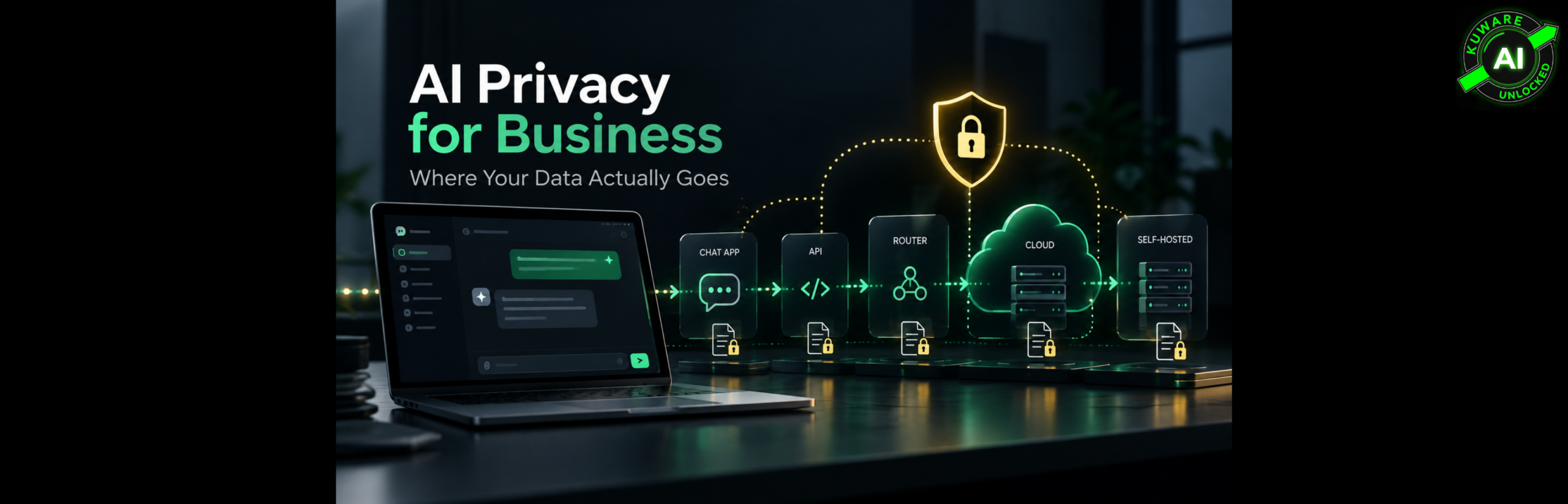
This is why we prefer to think in terms of a data path, not a privacy checkbox.
Ask:
Where did the prompt originate?
Where did it travel?
Who processed it?
Who stored it?
What did connected systems receive?
What gets deleted afterward?
Once you diagram that path, AI privacy becomes much easier to reason about.
Self-hosted does not automatically mean private
Kuware AI uses OpenWebUI as one of the ways to provide teams access to multiple models through a controlled interface.
That architecture can improve control significantly.
Conversation history can live on infrastructure you manage rather than inside several different consumer chat products.
But here is the part people miss.
If OpenWebUI sends a request to OpenAI, Anthropic, xAI, Mistral, or another remote API, the prompt still leaves your infrastructure.
You self-hosted the interface.
You did not self-host the model.
And if the server itself sits on DigitalOcean, AWS, Azure, Google Cloud, or another hosting provider, you have also introduced that infrastructure provider into your trust boundary.
Self-hosting changes the architecture.
It does not eliminate trust.
Running open weights locally is different
Now change one part of that architecture.
Instead of OpenWebUI calling a remote model API, load an open-weight model onto hardware you control.
That could be Llama, Mistral, DeepSeek, Qwen, or another model that can run on your own infrastructure.
Now the prompt can stay entirely within that environment.
That distinction is particularly important with DeepSeek.
Using DeepSeek’s hosted service and running DeepSeek model weights yourself are not remotely the same privacy architecture.
DeepSeek’s current privacy policy says its services directly collect, process, and store personal data in the People’s Republic of China.
But a DeepSeek model checkpoint running on a GPU inside your own VPC is simply software running on your machine. The prompt does not need to go to DeepSeek at all.
That difference gets lost constantly in conversations about open models.
Cloud-hosted open models create another middle ground
You do not necessarily have to choose between a frontier API and buying GPUs.
Services can host open models while offering stronger retention controls.
Ollama Cloud, for example, says its cloud models use zero data retention and are hosted in the United States and Europe, with Singapore available for a limited set of models.
That is different from calling the model creator’s own API.
Again, follow the data path.
Model identity does not tell you where your prompt goes. The inference provider does.
This becomes especially important when using routers.
OpenRouter is a router, not one giant model host
OpenRouter makes it possible to call many models through one interface.
That is useful.
It also creates another privacy decision.
A request for the same model can potentially be handled by different inference providers, and those providers may have different retention policies.
OpenRouter’s provider directory currently shows major differences across providers. Some endpoints offer zero retention. Some retain prompts for 30 days. Others retain prompts under different policies.
So if residency or retention matters, do not simply pick the model.
Control the provider too.
OpenRouter now supports US and EU in-region routing. Requests sent through its US endpoint remain with US provider endpoints, while its EU endpoint restricts processing to EU endpoints.
It also supports routing controls for provider selection, data collection, and ZDR.
That is useful infrastructure.
But it does not remove your responsibility to configure it correctly.
A routing layer is only as private as the rules you give it.
Data residency can matter as much as model choice
Mistral is worth noting for businesses with European data requirements.
Mistral says data is hosted in the European Union by default, although some features can involve transfers to subprocessors outside the EU. It also provides a US API endpoint for organizations that explicitly choose US hosting.
Its paid API plans can qualify for ZDR on supported stateless API calls. Stateful services such as agents, conversations, files, and libraries require storage and fall outside that ZDR scope.
That last sentence matters.
The moment an AI system needs memory, files, RAG, agents, or persistent state, the privacy architecture gets more complicated.
Which brings us to the risks businesses often overlook.
The biggest privacy leak may be your own employees
You can negotiate the best enterprise agreement in the world and still lose control because someone on the team pastes a customer spreadsheet into a personal AI account.
This is shadow AI.
And it is one of the most practical AI governance problems businesses face.
Someone needs an answer quickly.
The approved corporate system feels inconvenient.
They already have ChatGPT, Claude, Grok, Gemini, or another tool open.
So the data goes there.
No malicious intent required.
This is why an AI acceptable-use policy cannot simply say:
“Do not put confidential information into AI.”
You need to give employees an approved alternative that is almost as easy to use.
Governance without usable infrastructure rarely survives contact with real employees.
RAG and agents create a different privacy problem
Suppose your company builds an internal AI assistant connected to Google Drive, SharePoint, your CRM, Slack, and your accounting system.
The model provider might have excellent privacy terms.
You can still have a serious problem.
Why?
Because now the AI can reach your internal systems.
If permissions are too broad, a harmless-looking question can retrieve information the employee asking it was never supposed to see.
The issue is no longer:
“Will OpenAI train on this?”
The issue is:
“Why did this employee’s AI agent have access to the acquisition folder?”
That is an authorization problem.
And as businesses move from chatbots to agents, those problems become much more important.
You need to think about identity, permissions, document-level access, tool permissions, audit logs, and what actions an agent can take without human approval.
Outputs can leak information too
Privacy controls usually focus on inputs.
Do not forget outputs.
Long context windows can contain information from previous turns, retrieved documents, system instructions, tool responses, and other context the user may never see directly.
Poorly designed systems can accidentally expose pieces of that context.
Prompt injection makes this worse.
An external document, webpage, email, or retrieved file can contain instructions designed to manipulate an AI agent into exposing data or taking unintended actions.
So privacy is not only a vendor-contract problem.
It is also an application-security problem.
Regulations do not stop at “we don't train on your data”
HIPAA, GDPR, CCPA, contractual confidentiality requirements, legal discovery, financial regulations, and industry-specific rules deal with how information is collected, processed, transferred, retained, protected, and disclosed.
“No model training” addresses only one narrow slice of that.
For regulated or highly sensitive workloads, questions may include:
Who is the data processor?
Where is processing occurring?
Is there a signed DPA or BAA where required?
What gets logged?
How long is it retained?
Who has administrative access?
What subprocessors are involved?
What happens during a legal hold?
What happens when a user deletes something?
Can an agent reach systems outside its intended scope?
This is why AI privacy belongs inside architecture and governance, not inside a checkbox on a vendor comparison spreadsheet.
When should the customer own the box?
For some workloads, the cleanest architecture is straightforward.
Run the interface inside the customer’s environment.
Run open-weight models inside that environment.
Keep the vector database there.
Keep document storage there.
Control identity and permissions there.
Do not send prompts to an external frontier model.
For healthcare, legal, financial, intellectual-property-heavy, or other highly sensitive environments, that may be the right decision.
But there is a trade-off.
A locally hosted open model may not match a top frontier model on every reasoning task.
Private infrastructure also creates operational work. Someone has to handle updates, security patches, monitoring, backups, model deployment, GPU capacity, authentication, and failures.
That is not a reason to avoid it.
It is a reason to make the architecture decision consciously.
Hybrid is often the practical answer
Businesses do not have to choose one model architecture for everything.
A useful pattern is:
Keep highly sensitive data and routine workloads inside a controlled private environment.
Use enterprise APIs with appropriate retention controls for workloads that need stronger frontier-model performance.
Use different models based on the sensitivity and difficulty of the task.
Put routing and policy controls between the employee and the models.
That is a perfectly reasonable architecture.
Just do not call it “fully private” if some prompts still leave your environment.
Precision matters.
The AI privacy question businesses should actually ask
Stop asking only:
“Does this company train on our data?”
Ask instead:
“Show us the entire path our data takes.”
That question changes everything.
It forces you to look at the AI interface, model provider, inference host, router, application logs, cloud infrastructure, RAG database, connected systems, employee permissions, retention settings, and legal requirements.
That is what real AI privacy looks like.
Not a toggle.
Not a vendor logo.
Not “enterprise-grade” written on a pricing page.
An architecture you understand and control.
