Everyone’s building agents right now.
And honestly… most of them are just fancy prompts.
They look smart in demos. They fall apart in real use.
Why?
Because they forget everything.
The Problem Nobody Talks About
Let’s be blunt.
Most AI systems today are stateless.
You ask something.
It answers.
Next question? Clean slate.
It answers.
Next question? Clean slate.
No memory. No learning. No continuity.
That’s fine for one-off tasks.
But the moment you try to use AI for real work like research, coding, marketing, customer support, it breaks.
It keeps repeating the same thinking.
Re-solving the same problems.
Re-learning what it already “knew” yesterday.
Re-solving the same problems.
Re-learning what it already “knew” yesterday.
That’s not intelligence.
That’s expensive autocomplete.
What Andrew Ng’s Course Gets Right
The Agent Memory: Building Memory-Aware Agents (from DeepLearning.AI, introduced by Andre Ng, taught by Richmond Alake and Nacho Martínez) frames this shift very clearly:
Memory is what turns an LLM into an agent that improves over time.
And that sounds simple. But it’s actually a massive architectural shift.
The Core Idea: The Brain Outside the Skull
LLMs have a hard limit. Context window.
You can’t just keep stuffing everything into prompts.
So what do you do?
You move memory outside the model.
Think of it like this:
- LLM = reasoning engine
- Memory system = long-term brain
That external memory could be:
- A database
- A vector store
- A structured knowledge base
But the key is this:
👉 The agent decides what to remember and what to recall
The Three Types of Memory (This Actually Matters)
This is one part of the course that’s more important than it looks at first glance.
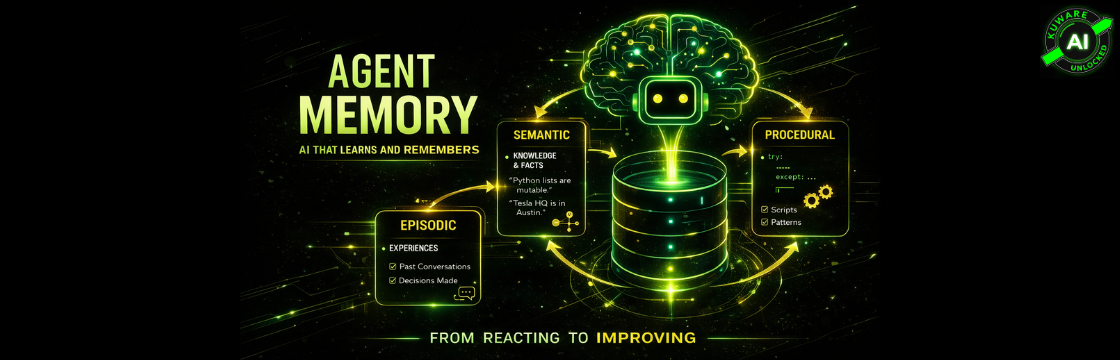
1. Semantic Memory
Facts. Pure knowledge.
- Python lists are mutable
- Tesla HQ is in Austin
- Google Ads CPC trends matter
Stored as embeddings. Retrieved via similarity.
This is your knowledge layer.
2. Episodic Memory
What happened.
- Conversations
- Decisions
- Outcomes
Think of it as a diary.
Your agent remembers:
- What it tried
- What worked
- What failed
This is where continuity comes from.
3. Procedural Memory
How to do things.
- Workflows
- Scripts
- Patterns
This is the most underrated one.
Because this is where the agent stops being reactive and starts being efficient.
It doesn’t just answer.
It executes.
The Missing Piece: The Memory Manager
This is the real system. Not the LLM.
The Memory Manager is doing three things constantly:
- Read Pull only what’s relevant Not everything
- Write Save useful outcomes Not noise
- Store Keep it structured and retrievable
If you don’t have this layer, you don’t have memory.
You just have storage.
The Loop That Changes Everything
Once memory is in place, your agent stops being a one-shot responder.
It becomes a loop:
					User Input
→ Retrieve Memory
→ Reason
→ Act
→ Write Back
That last step is the game changer.
Because now the system learns.
Not theoretically. Practically.
A Simple Example (But This Is Where It Clicks)
Let’s say you have a research agent.
Day 1:
- Scrapes papers
- Summarizes findings
- Stores insights
Day 2:
- Loads previous knowledge
- Skips duplicates
- Builds on prior work
That’s not just automation anymore.
That’s compounding intelligence.
The Part Most People Get Wrong
Everyone gets excited about storing memory.
Nobody thinks hard enough about what not to store.
And this is where systems break.
Memory Bloat
If you store everything:
- Retrieval slows down
- Prompts get polluted
- Signal gets buried in noise
Memory Drift
If you don’t clean memory:
- Old assumptions stick
- Wrong conclusions persist
- The agent gets worse over time
The Hard Problem: Forgetting
The course touches on this. But in practice, this is the real challenge.
Good agents don’t just remember.
They forget intelligently.
You need:
- Importance scoring
- Summarization pipelines
- Consolidation (episodic → semantic)
- Deletion of low-value data
Otherwise your “smart” system turns into a cluttered mess.
Why This Matters for Real Businesses
Now let’s bring this into your world.
Because this is where it gets interesting.
Marketing Systems
Imagine an agent that:
- Remembers campaign performance
- Learns which ads convert
- Adjusts recommendations automatically
That’s not a tool.
That’s a system with experience.
Customer Support
Instead of:
- Repeating answers
- Asking the same questions
You get:
- Context-aware responses
- Personalization
- Faster resolution
Internal AI (This is the Big One)
Your internal tools become:
- Smarter every day
- Aligned with your workflows
- Harder to replace
Because the value is not in the model.
It’s in the memory.
The Real Insight (This Is the Shift)
Most people think AI progress is about better models.
It’s not.
It’s about better systems around the model.
And memory is the most important part of that system.
Final Thought
If I had to say it in one line:
Without memory, AI is just reacting.
With memory, AI starts improving.
With memory, AI starts improving.
And once it improves…
You’re no longer building tools.
You’re building assets.
