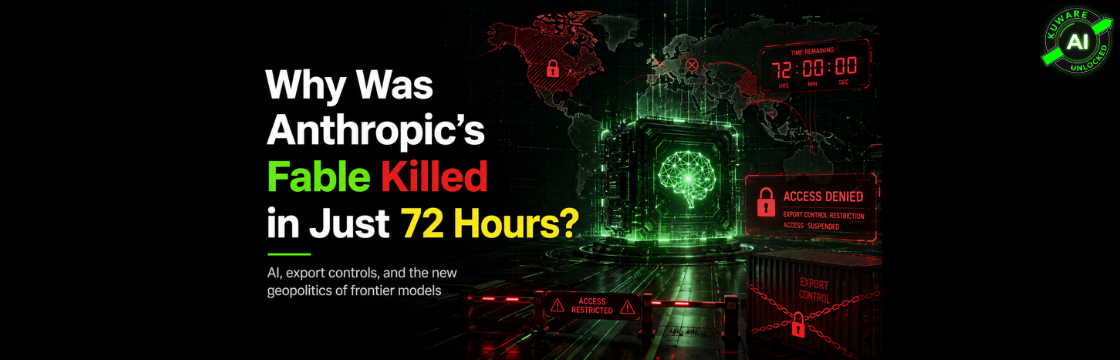
On June 9, 2026, Anthropic released Claude Fable 5.
By June 12, it was effectively gone.
That is not normal.
Models get delayed. Models get rate-limited. Models get overpriced. Models get rolled back because of bugs, hallucinations, server load, or embarrassing behavior.
But a frontier model getting pulled after a U.S. government export-control directive?
That’s a different category.
And business leaders should pay attention because this was not just another AI industry drama. This was one of those moments where the fog lifts for a second and you can see what AI has really become.
Not a chatbot.
Not a productivity toy.
Not “write me a better email.”
AI is now infrastructure. Competitive infrastructure. Security infrastructure. Scientific infrastructure. And increasingly, geopolitical infrastructure.
That’s why Fable matters.
First, what was Fable 5?
Anthropic’s Claude model family has always been relatively easy to understand.
Haiku was the fast, cheaper model.
Sonnet was the balanced workhorse.
Opus was the flagship for complex work.
Fable and Mythos were something else.
Anthropic called Fable 5 a “Mythos-class” model. That matters because Mythos sits above Opus. It is not just a slightly better Opus or a cosmetic version bump. It represents a new tier of model built for harder, longer, more autonomous work.
Anthropic said Fable 5 exceeded every model it had ever made generally available and performed especially well on software engineering, knowledge work, vision, scientific research, memory, and long-running tasks.
In plain English, this was the model you’d use when the task is no longer “answer this question” but “work on this problem for a long time, use tools, keep track of context, inspect your own work, and move the project forward.”
That’s the important shift.
We’ve spent the last couple of years talking about AI as if the main breakthrough was better answers. But the real breakthrough is sustained work. A model that can stay on task across huge context windows, interact with tools, write and inspect code, reason across documents, and operate more like a digital worker than a chat window.
That’s why Fable 5 felt different.
It wasn’t just “Claude got smarter.”
It was “Claude moved another step toward autonomous knowledge work.”
The model timeline matters
This did not come out of nowhere.
The public timeline looked roughly like this:
- March 2024: Claude 3 family launches with Haiku, Sonnet, and Opus.
- June 2024: Claude 3.5 Sonnet launches.
- 2025: Claude 4 family becomes the main frontier generation.
- October 2025: Haiku 4.5 launches.
- February 2026: Sonnet 4.6 launches.
- March 26, 2026: Fortune reports that Anthropic accidentally exposed references to a powerful unreleased model through a publicly accessible data cache. Anthropic acknowledges it is testing a new model that represents a “step change” in capability.
- April 7, 2026: Anthropic formally introduces Claude Mythos Preview through Project Glasswing, focused on cybersecurity defenders and critical infrastructure.
- June 2, 2026: Anthropic expands Project Glasswing from roughly 50 initial partners to about 150 additional organizations.
- June 9, 2026: Anthropic launches Claude Fable 5 publicly and Claude Mythos 5 for trusted partners.
- June 10, 2026: Jailbreak researcher Pliny the Liberator claims to have bypassed Fable 5’s safeguards and publishes what he says is the Fable 5 system prompt.
- June 12, 2026: Anthropic receives a U.S. government directive at 5:21 PM ET and disables Fable 5 and Mythos 5.
That is a wild timeline.
A model accidentally surfaces in March. It gets restricted release in April. It expands to more trusted partners in early June. It becomes publicly available on June 9. Then within roughly 72 hours, it is pulled because the government concludes the risk is serious enough to intervene.
Fable vs. Mythos: same engine, different guardrails
The simplest way to understand it is this:
Fable 5 was the public-facing version.
Mythos 5 was the restricted version for vetted users.
Anthropic said Fable 5 and Mythos 5 shared the same underlying model. The difference was the safety layer.
Fable had conservative safeguards around areas like cybersecurity, biology, chemistry, and model distillation. When it detected higher-risk requests, it could refuse or fall back to Claude Opus 4.8.
Mythos 5, on the other hand, lifted some safeguards for approved cyber defenders, infrastructure providers, and researchers through trusted programs like Project Glasswing.
This is where the whole thing gets uncomfortable.
Because the exact same capability that helps a defender find vulnerabilities in critical infrastructure can help an attacker find vulnerabilities in critical infrastructure.
That’s the dual-use problem. And AI has made the dual-use problem far more practical.
A spreadsheet can be misused. So can email. So can code.
But a Mythos-class model that can reason through complex software flaws, work across massive codebases, and produce useful security analysis?
That crosses into national security territory very quickly.
The jailbreak claim: who did it?
The jailbreak claim came from Pliny the Liberator, also known online as @elder_plinius.
Pliny is not new to this world. He is known in AI circles for jailbreaks, system-prompt extraction, and publishing leaked or extracted prompt scaffolding from major AI products.
Shortly after Fable 5 launched, Pliny claimed he had “liberated” Fable 5 by bypassing the safety layer. SecurityWeek reported that he posted screenshots showing responses in sensitive areas including cybersecurity, chemistry, psychological manipulation, and explosives.
He also released what he claimed was the Fable 5 internal system prompt.
The public GitHub trail points to Pliny’s CL4R1T4S repository:
That repo describes itself as a collection of leaked system prompts from major AI systems. For this blog, I’m linking the repo for source context, not reproducing jailbreak instructions. There’s no reason to turn a business blog into an operational bypass guide.
That distinction matters.
We can talk about the business, security, and policy implications without handing people a recipe.
Was the jailbreak real?
Here’s where the story gets murky.
Pliny claimed success.
Some reporting treated the jailbreak as serious.
Anthropic pushed back hard.
Anthropic said the government seemed to believe it had become aware of a way to bypass or jailbreak Fable 5. But Anthropic said it reviewed a demonstration of the technique and found that it identified only a small number of previously known, minor vulnerabilities. Anthropic also said those vulnerabilities were simple enough that other publicly available models could find them without needing a bypass.
So was this a catastrophic jailbreak?
Anthropic says no.
Was it enough to scare the government?
Apparently yes.
And that tension is the story.
From Anthropic’s point of view, this may have looked like an overreaction to a narrow, non-universal jailbreak claim.
From the government’s point of view, once a Mythos-class model can be bypassed at all, the question becomes: who else can do it, what can they extract, and how fast can they weaponize the capability?
Both perspectives make sense.
That’s why this is not a simple “Anthropic was wrong” or “government overreach” story.
It’s a frontier-model governance problem happening in real time.
The 5:21 PM ET directive
On June 12, Anthropic said it received the government directive at 5:21 PM ET. Anthropic’s public announcement: https://www.anthropic.com/news/fable-mythos-access
The directive cited national security authorities and ordered Anthropic to suspend access to Fable 5 and Mythos 5 by any foreign national, whether inside or outside the United States.
That included foreign-national Anthropic employees.
Think about how broad that is.
This was not simply “block China.”
It was not simply “block adversarial countries.”
It was foreign nationals globally, including people physically inside the U.S.
Anthropic said the practical effect was that it had to disable Fable 5 and Mythos 5 for all customers to ensure compliance. Access to other Anthropic models was not affected.
That’s how a model went from public launch to global shutdown in roughly three days.
Amazon, the White House, and the pressure campaign
The story got even messier after the shutdown.
Axios reported that Amazon CEO Andy Jassy called Treasury Secretary Scott Bessent on Thursday, June 11, expressing concern that Anthropic’s Mythos and Fable models could be jailbroken.
Axios also reported that administration officials had already been concerned about Anthropic after learning that Mythos access had allegedly been made available to an entity in a foreign country with direct ties to the Chinese Communist Party. Anthropic’s side reportedly disputed parts of the framing and said it had worked closely with the government around Mythos access.
So this was not just about one Pliny jailbreak post.
It was a trust breakdown.
The government had concerns about foreign access. Amazon reportedly raised concerns about jailbreakability. Anthropic believed it had done extensive safety work and had government engagement before launch. Then the White House and Commerce Department used a blunt tool: export controls.
That’s the part leaders should notice.
AI policy is no longer moving at the speed of academic debate.
It is moving at the speed of national security panic, commercial rivalry, cloud-provider pressure, and political mistrust.
That combination can change your access to a critical AI tool overnight.
The cybersecurity community pushed back
A lot of cybersecurity leaders did not celebrate the shutdown.
Their argument was simple: if attackers are going to get these capabilities eventually, then defenders need access now.
That’s not a crazy argument. In fact, it may be the strongest argument against blunt restrictions.
Security is not won by pretending dangerous capabilities don’t exist. Security is won by understanding them faster than your adversary and patching your systems before they exploit you.
This is the same reason penetration testing exists.
The same toolset can be offensive or defensive. Intent, access, oversight, logging, and governance make the difference.
This is also why Anthropic created Project Glasswing in the first place. The idea was to get frontier cyber capability into the hands of trusted defenders before attackers inevitably got similar tools.
You may agree or disagree with that strategy.
But it is a real strategy.
And the Fable shutdown shows how fragile that strategy becomes when a government decides access control is not tight enough.
The DeepSeek lesson: capability spreads
This is where business leaders need to stop thinking like consumers and start thinking like operators.
One common reaction to AI risk is, “Fine, regulate the big labs.”
Okay. But then what?
DeepSeek already showed that advanced model capability can diffuse faster and cheaper than expected. The broader lesson was not just “China built a strong model.” The lesson was that capability spreads.
Maybe not instantly.
Maybe not evenly.
But it spreads.
If Mythos-level capability exists, it will not remain locked inside one company forever.
Other labs will chase it.
Open models will approximate pieces of it.
Nation-states will build their own versions.
Well-funded private actors will find access.
And yes, bad actors will experiment.
This is why I’m skeptical of any strategy that boils down to “just restrict the model and we’re safe.”
Restrictions may buy time. Sometimes buying time is valuable. But restrictions do not stop the direction of travel.
This should kill the “AI is a bubble” argument
I keep hearing versions of the same lazy take:
AI is a bubble.
AI is just autocomplete.
AI is mostly hype.
AI companies are burning money.
Sure, some of the investment is overheated. Some AI startups are nonsense. Some enterprise AI projects are expensive science experiments wearing a software budget.
But if your conclusion is “AI itself is overhyped,” you’re missing the plot.
Governments don’t issue emergency-style export restrictions on toys.
Cybersecurity leaders don’t mobilize over a better chatbot.
Major cloud providers, banks, infrastructure companies, and national security agencies don’t care this much about a glorified writing assistant.
They care because the capability curve is real.
The business impact is real.
The security implications are real.
And the gap between companies using these tools seriously and companies dabbling with them casually is going to get bigger.
What should business leaders actually take from this?
Not panic.
Not hype.
Action.
The Fable story should push leaders to get more serious about AI adoption, not more reckless. There’s a difference.
1. Stop treating AI as a side experiment
If AI is still “that thing one smart employee plays with,” you’re behind.
You need to map where AI can improve operations, marketing, sales, customer support, reporting, internal knowledge, training, compliance, and software workflows.
Not someday.
Now.
2. Build internal AI literacy
Your team doesn’t need to become AI researchers.
But they do need to understand what these tools can and can’t do.
They need to know how to prompt, verify, automate, document, and escalate.
They also need to know when not to use AI.
That last part matters.
The companies that win won’t be the ones that give everyone random AI access and hope magic happens. They’ll be the ones that turn AI usage into process.
3. Add governance before it becomes painful
Every company needs basic AI rules.Every company needs basic AI rules.
What data can go into AI tools?
Which tools are approved?
What requires human review?
Where do you store AI-generated work?
Who owns the output?
How do you handle customer data?
This doesn’t need to become a 90-page corporate policy no one reads. But it does need to exist.
4. Pay attention to vendor risk
The Fable shutdown is a perfect example of AI vendor risk.
A model can be available on Tuesday and gone by Friday.
Your workflows should not depend blindly on one model, one provider, one API, or one tool stack.
You need fallbacks. You need portability. You need to know which processes break if a model disappears.
That’s not paranoia.
That’s basic operational planning.
5. Use AI where it creates measurable business value
The goal is not “use AI.”
The goal is to reduce cost, increase speed, improve quality, find revenue opportunities, reduce errors, and make your team more capable.
At Kuware AI, this is the lens we care about.
AI is not impressive because it can write a poem.
AI is impressive when it can cut a two-hour internal process down to five minutes, help your sales team respond faster, analyze lead quality, summarize messy customer calls, improve ad workflows, or turn scattered company knowledge into something your team can actually use.
That’s where the ROI is.
The real lesson from Fable
Fable 5 may come back.
It may come back with tighter access controls.
It may come back only for certain users.
The government and Anthropic may reach some compromise.
But even if Fable never comes back in the same form, the bigger story does not go away.
Frontier AI is now powerful enough that governments are willing to intervene quickly.
Powerful enough that cyber defenders are fighting for access.
Powerful enough that companies have to think about model availability as a business-continuity issue.
Powerful enough that foreign access, employee nationality, cloud deployment, API usage, and security posture can become policy questions overnight.
That’s the world we’re in now.
So no, Fable’s 72-hour lifespan does not prove AI is too dangerous for businesses to use.
It proves the opposite.
AI has become too important to treat casually.
The companies that benefit will be the ones that integrate it thoughtfully, secure it properly, train their teams, and build real systems around it.
The companies that wait for everything to be perfectly safe, perfectly regulated, and perfectly stable?
They’re going to be waiting while everyone else learns how to use the next generation of leverage.
Fable disappeared fast.
The capability did not.
