There are startup stories that feel fast.
Then there is Cursor.
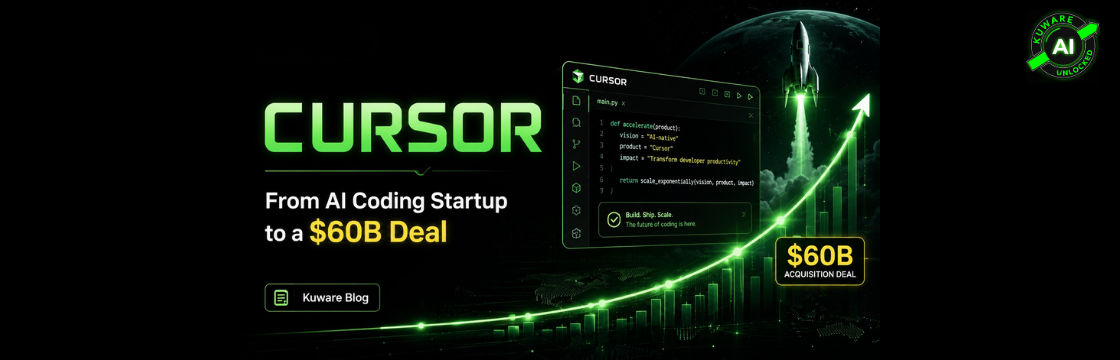
Four MIT classmates started Anysphere in 2022. Their product, Cursor, began as an AI-powered coding environment built on top of the familiar VS Code experience. By 2026, the company was reportedly moving toward a $60 billion all-stock acquisition by SpaceX.
That sentence sounds fake.
And honestly, a few years ago, it would have been fake. Developer tools were not supposed to become $60 billion companies in four years. Coding editors were not supposed to grow like consumer apps. Enterprise software was not supposed to go from young startup to billion-dollar run-rate this fast.
But AI has changed the clock speed of business.
Cursor is not just a story about coding. It is a story about what happens when a company builds directly into a platform shift instead of treating the shift like a feature request.
That is the real lesson here.
The Origin Story Was Not Magic
Cursor did not begin as a perfect idea.
The founders, Michael Truell, Sualeh Asif, Aman Sanger, and Arvid Lunnemark, met through MIT. Before Cursor became the product everyone talks about today, they explored other ideas that did not take off. That part matters because the public version of startup history always gets cleaned up after the fact.
People like to tell the story as if four young geniuses woke up one morning, saw the future, and built a $60 billion company.
That is not how this works.
They experimented. They missed. They paid attention. Then they moved into the market at exactly the right moment.
By 2023, developers were already using GitHub Copilot and GPT-4. The promise was obvious: AI could help write, edit, explain, and debug code. But the experience still felt bolted on. It was helpful, but it did not yet feel like the IDE itself had been redesigned around AI.
Cursor’s bet was simple and powerful: don’t make AI an add-on. Make the editor AI-native.
That is a very different product philosophy.
Why the VS Code Fork Was Smart
Cursor did not try to make developers relearn everything from scratch.
That was a big part of the genius.
Instead of building a totally foreign interface, Cursor used a VS Code fork as the base. Developers could keep the shortcuts, extensions, themes, and muscle memory they already had. The familiar workflow stayed intact.
But underneath that familiar surface, Cursor started changing the relationship between developer and editor.
You could highlight code and ask for changes. You could chat with the codebase. You could generate, refactor, explain, and debug inside the same environment where you were already working. Over time, that shifted from “AI assistant inside the editor” to “AI agent that understands the project.”
That is a huge difference.
Most AI features fail because they interrupt the real workflow. Cursor won because it fit into the workflow first, then slowly expanded what the workflow could become.
That is something every business owner should pay attention to.
The best AI products are not always the ones with the flashiest demo. They are the ones that slide into an existing daily habit and make it hard to go back.
The Growth Numbers Are Almost Absurd
Cursor’s growth has been reported as one of the fastest ramps in modern SaaS history.
The company publicly said it crossed $1 billion in annualized revenue by late 2025. Reports in 2026 suggested that number had continued climbing quickly, with some estimates putting annualized revenue in the multi-billion-dollar range.
The exact number will depend on how revenue is counted, how enterprise contracts are structured, and what gets included in run-rate calculations. But we do not need to pretend every number is perfectly clean to see the obvious truth:
Cursor grew insanely fast.
And it did that in a market where the buyers were not casual users. These were developers, startups, enterprise engineering teams, and large companies that actually depend on code production.
That is what makes the story more interesting.
This was not another AI toy with viral signups and weak retention. Cursor became part of how real teams ship software. When an AI tool moves from “interesting” to “part of production,” the economics change fast.
The Real Product Was Speed
People often describe Cursor as an AI coding tool.
That is accurate, but incomplete.
The real product was speed.
Speed to understand a codebase. Speed to make changes. Speed to test ideas. Speed to help junior developers move faster. Speed to help senior developers avoid tedious work. Speed to turn a vague idea into working software.
That is why tools like Cursor matter beyond software engineering.
Every company is becoming more software-dependent. Even businesses that do not think of themselves as software companies now need automations, internal tools, integrations, reporting dashboards, customer portals, workflow apps, and AI agents.
The old bottleneck was: “We need developers.”
The new bottleneck is becoming: “We need people who can clearly define what should be built, manage AI-assisted development, and validate the result.”
That is a very different world.
And it is exactly why Cursor became so valuable.
The Model-Agnostic Move Was Critical
Another important part of Cursor’s strategy was model flexibility.
Cursor did not tie its entire future to one model provider. Users could work with models from OpenAI, Anthropic, Google, xAI, and Cursor’s own models. That mattered because the model race keeps changing.
One month, OpenAI looks ahead. Then Anthropic launches a coding model that developers love. Then Google comes back with a stronger Gemini release. Then xAI pushes Grok. Then a specialized model beats bigger models on a narrow coding workflow.
In that environment, the application layer needs flexibility.
Cursor understood something many AI product builders still miss: users do not care which model wins this week. They care whether the job gets done.
That is why the interface, workflow, context management, speed, and reliability become the moat. The model matters, of course. But the product wrapper around the model often determines whether people actually use it every day.
This is one of the biggest lessons for businesses building with AI right now.
Do not build your entire strategy around a single model. Build around the workflow. The models will keep changing.
Then Came the Compute Problem
As Cursor grew, it faced the same issue every serious AI company eventually faces.
Compute.
AI at scale is not cheap. Running coding agents, autocomplete, context-aware editing, codebase search, model inference, and proprietary training takes serious infrastructure. The better the product gets, the more compute-hungry it becomes.
That is where the SpaceX story gets interesting.
Before the acquisition reports, Cursor announced a partnership with SpaceX to scale model training using xAI’s Colossus infrastructure. Cursor had been building its own Composer models and needed more compute to push them further.
This was not just a vanity partnership.
If you are building AI-native software, compute is not a back-office expense. It is part of product strategy. It affects latency, model quality, pricing, margins, and the speed of improvement.
For Cursor, access to massive compute could help it reduce dependence on outside model providers and improve its own models faster.
For SpaceX and xAI, Cursor offered something equally valuable: a real enterprise product, a developer ecosystem, and a massive amount of usage around code generation and software workflows.
That is the strategic logic.
The $60 Billion Deal
In April 2026, reports said SpaceX structured a partnership that included an option to buy Cursor for $60 billion. In June 2026, multiple reports said SpaceX agreed to acquire Cursor in an all-stock deal, with closing expected in Q3 2026.
That is the cleanest way to say it.
Not “already fully integrated.”
Not “done forever.”
A reported agreement, not yet closed.
Still, even with that caveat, the number is stunning.
A $60 billion price tag for a company founded in 2022 tells you how much the market now values the AI application layer when it has real usage, real revenue, enterprise adoption, and strategic data.
It also says something about the direction of AI competition.
The big model labs are not just competing on chatbots anymore. They are competing for distribution into actual workflows. Coding is one of the first massive workflow categories where AI has obvious daily value.
If you own the place where developers build, test, refactor, and ship code, you own a very valuable layer of the AI economy.
SpaceX appears to understand that.
Why Cursor Won
Cursor won because it was AI-native from the beginning.
Not “AI-enhanced.” Not “AI sprinkled on top.” AI-native.
That distinction matters.
A traditional software company usually asks, “Where can we add AI features?”
An AI-native company asks, “If AI is available from day one, how should the entire workflow change?”
Cursor answered that question better than most.
It also had excellent timing. GPT-4 made developers believe AI coding could be useful. Claude made long-context coding assistance stronger. The agent wave made people comfortable with AI taking on bigger tasks. Enterprises started caring because engineering productivity is expensive.
Cursor rode all of that, but it did not simply get lucky.
Plenty of companies had access to the same models. Plenty of companies saw the same trend. Cursor executed.
It kept the familiar editor experience. It moved fast. It obsessed over developer workflow. It supported multiple models. It built its own models where latency and cost mattered. It expanded from autocomplete into agents. And it found a way into enterprise teams without killing the product-led motion that made developers love it in the first place.
That is not luck.
That is execution inside a platform shift.
The Lesson for Business Owners
Most businesses should not look at Cursor and think, “We need to build the next $60 billion AI company.”
That is the wrong takeaway.
The better question is:
Where in your business is there a daily workflow that AI could completely reshape?
Not slightly improve. Reshape.
For a law firm, it might be document review and case preparation.
For a plumbing company, it might be call intake, estimate generation, technician dispatch, and follow-up.
For a marketing agency, it might be reporting, ad analysis, content creation, lead scoring, campaign QA, and client communication.
For a SaaS company, it might be onboarding, support, product analytics, and customer success.
The Cursor story proves that the biggest AI wins happen when you go deep into a workflow people already care about.
Generic AI is useful.
Workflow-native AI is valuable.
That is the difference.
The Part Nobody Should Ignore
There is one more thing here that people do not like to talk about.
AI tools are powerful, but they are not magic. Cursor still requires judgment. AI-generated code still needs review. Agents still make mistakes. Large-scale AI development can create messy architecture, hidden bugs, security issues, and maintainability problems if nobody experienced is watching.
This is where hype gets dangerous.
The future is not “AI replaces every developer.”
The future is closer to “people who know how to direct AI replace people who refuse to learn how to work with it.”
That is true far beyond coding.
AI will not remove the need for business judgment. It will punish businesses that do not have it.
What Cursor Really Represents
Cursor is a coding product, yes.
But it is also a signal.
It tells us that AI-native tools can compress years of software growth into months. It shows that enterprise buyers will adopt AI quickly when the value is obvious. It proves that product experience still matters, even in a world obsessed with models. And it reminds us that the application layer may be just as valuable as the model layer, sometimes more valuable.
For Kuware, this is the part we care about most.
The winners in AI will not be the companies that simply “use ChatGPT.”
The winners will be the companies that rebuild real workflows around AI, measure the impact, and keep improving the system until it becomes part of how the business operates every day.
Cursor did that for developers.
The next Cursor-like opportunity may come from legal operations, home services, healthcare administration, financial workflows, sales enablement, or marketing execution.
The pattern is already visible.
Find a painful workflow. Make AI native to it. Keep the human in control where judgment matters. Use models flexibly. Build for speed. Measure results.
That is the playbook.
And Cursor just showed the world how valuable that playbook can become.
