I still remember sitting in my dorm room in 1989.
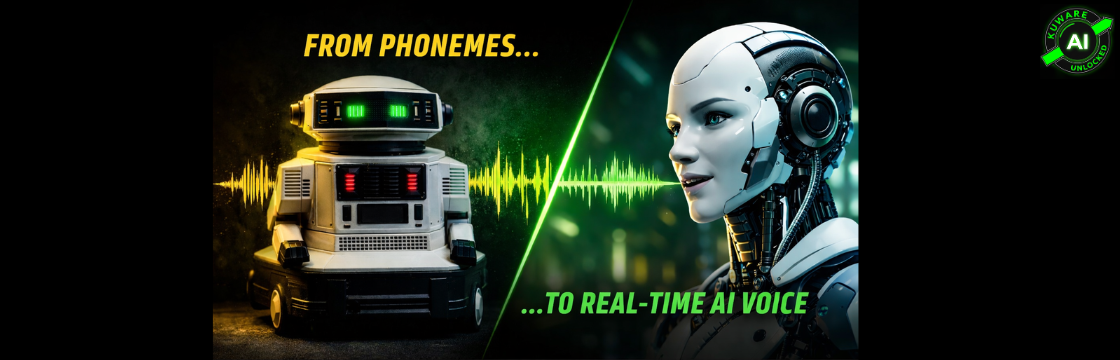
I had just built a Heathkit HERO Jr. robot. About knee-high. Rolled around the room. Looked futuristic at the time.
And if I wanted it to speak…
I didn’t type words.
I typed phonemes.
Literal sound codes.
Something like:
1F 1E 2C 1B 1F 26…
That’s how I made it sing the Wartburg College fight song.
And people thought that was magic.
Fast forward to today.
I can type a sentence… or not even type… just speak…
And an AI responds back in a voice so natural you forget it’s not human.
That jump? It’s not incremental.
It’s a complete architectural shift.
Let’s break it down.
The Two Core Pillars of AI Audio
At the highest level, audio AI splits into two systems:
1. Speech-to-Text (STT / ASR)
This is where machines listen.
Also called Automatic Speech Recognition.
2. Text-to-Speech (TTS)
This is where machines talk.
Everything else is built on top of these two.
But the way these pipelines work today vs even 5 years ago… completely different.
Speech-to-Text Pipeline (ASR): How Machines Hear You
Modern ASR is nothing like the old systems.
The pipeline today looks like this:
- Audio Input
Raw waveform comes in. - Feature Extraction
Converted into log-mel spectrograms (frequency maps of sound). - Neural Encoder
Transformer or Conformer models process patterns in speech. - Decoder
Outputs text tokens. - Post-processing
Clean text, punctuation, timestamps.
What changed everything?
Scale + Transformers.
Models like:
- Whisper
- Google Gemini (audio-native modes)
- Deepgram Nova
These models don’t just hear words.
They handle:
- Accents
- Noise
- Multiple speakers
- Context
Top Speech-to-Text Leaders (2026)
Batch Accuracy Leaders (Offline)
- ElevenLabs Scribe v2
- Google Gemini variants
- Mistral Voxtral
- NVIDIA Canary / Parakeet
- AssemblyAI Universal
These optimize for accuracy, not speed.
Real-Time Leaders (What Actually Matters for Chatbots)
- Deepgram Nova-3
- ElevenLabs Scribe Realtime
- NVIDIA Parakeet
- Google Gemini Streaming
- Speechmatics
Here’s the key insight:
👉 Batch leaderboards don’t matter for real-world voice apps.
Latency does.
If your system takes even 1–2 seconds too long, the conversation feels broken.
Text-to-Speech Pipeline (TTS): How Machines Talk
Now let’s flip it.
How does AI generate voice?
Old World (What I worked with in 1989)
- Phoneme-based synthesis
- Formant synthesis
- Pre-recorded fragments
You literally had to define how words sound.
No emotion. No tone. No variation.
Just robotic output.
Modern TTS Pipeline
- Text Input
- Grapheme-to-Phoneme (G2P) Happens automatically now
- Prosody Modeling Adds rhythm, pitch, emotion
- Acoustic Model
Generates spectrogram - Tacotron
- FastSpeech
- VITS
- Vocoder
Converts to waveform - HiFi-GAN
- WaveNet
The Big Leap: Audio as Tokens
Models like:
- VALL-E
Treat audio like language.
They:
- Compress speech into tokens
- Use transformer models
- Generate voice like predicting text
That’s why:
👉 3 seconds of your voice = full voice clone
Top TTS Players Today
Real-Time (For Chatbots)
- Cartesia Sonic (fastest)
- ElevenLabs Turbo
- Play.ht Streaming
- Azure Neural TTS
- Inworld TTS
Batch (For Content Creation)
- Inworld TTS 1.5
- ElevenLabs v3
- MiniMax Speech
- StepFun TTS
Again:
👉 Batch = quality
👉 Real-time = experience
👉 Real-time = experience
And experience wins.
Batch vs Real-Time: The Hidden Divide
Most people miss this.
They look at leaderboards and think:
“Let’s pick the #1 model.”
That’s a mistake.
Because:
Batch Systems Optimize:
- Accuracy
- Naturalness
- Post-processing
Real-Time Systems Optimize:
- Latency (<300ms)
- Streaming stability
- Interruptions
If you’re building:
- Audiobooks → Batch matters
- Voice chatbot → Real-time matters
Completely different problem.
Why Integrated Voice APIs Are Winning
This is where things get really interesting.
Traditionally, you had:
Speech → ASR → LLM → TTS → Audio
Each step adds delay.
Each step can break.
Modern Approach: End-to-End Voice
Systems like:
- OpenAI Realtime API
- Google Gemini Live
- Amazon Nova Sonic
Skip the pipeline.
They do:
👉 Speech → Thinking → Speech
All inside one model.
Why this matters:
- Faster
No handoffs between systems - More Natural
No “translation artifacts” - Better Interruptions
You can talk over the AI - Context Aware
Tone and meaning preserved
I’ve tested this extensively.
And honestly…
Even if you pick the “best” ASR and “best” TTS separately…
It still feels worse than an integrated system.
Deepgram vs OpenAI vs Integrated Systems
There are two philosophies:
1. Best-in-class components
Example:
- Deepgram (STT)
- External LLM
- External TTS
Pros:
- Flexibility
- Control
Cons:
- Latency
- Complexity
2. Integrated Voice Systems
Example:
- OpenAI Realtime
- Gemini Live
Pros:
- Speed
- Simplicity
- Better UX
Cons:
- Less modular control
For production voice chatbots?
👉 Integrated wins.
Full Circle: From Phonemes to Intelligence
Let me bring this back to where we started.
In 1989:
- I had to manually define sound
- No understanding
- No context
- No intelligence
Today:
- AI understands speech
- Responds intelligently
- Speaks naturally
- Adapts tone and emotion
And the biggest shift?
👉 Voice is no longer output.
👉 Voice is the interface.
Where This Is Going
Every business will end up with:
- A voice layer
- A knowledge base
- A real-time AI interface
Not chatbots.
Voice agents.
And the companies that win?
Not the ones picking the best model.
The ones building the best experience.
Final Thought
I still think about that little HERO Jr. robot sometimes.
Rolling around the dorm…
Singing in that robotic voice…
And how long it took me just to make it say one sentence.
Now?
You can build a voice AI agent in a weekend.
And it’ll sound more human than anything we imagined back then.
If that doesn’t tell you how fast this space is moving…
Nothing will.
