What It Really Takes (Not the Checkbox Version)
Let me say this upfront.
Most people asking about HIPAA compliance for AI are really asking the wrong question.
They’re asking:
“Is this tool HIPAA compliant?”
“Is this tool HIPAA compliant?”
That’s not how this works.
HIPAA compliance is not a feature you turn on.
It’s a system.
A discipline.
A set of decisions across your entire stack.
A discipline.
A set of decisions across your entire stack.
And if you’re building AI apps for clients, like we are, you don’t get to outsource that responsibility.
You own it.
Why This Matters More With AI
Before AI, most healthcare systems were fairly predictable.
Database here.
App server there.
Access through controlled interfaces.
App server there.
Access through controlled interfaces.
Now?
You’ve got LLMs.
APIs sending data out and back.
Vector databases storing embeddings.
Logs. Memory. Context windows.
APIs sending data out and back.
Vector databases storing embeddings.
Logs. Memory. Context windows.
Data is moving. Constantly.
And if any of that data includes PHI (Protected Health Information), you are in HIPAA territory whether you like it or not.
So yeah… this matters.
Let’s Simplify It First
At a very practical level, HIPAA compliance in AI systems comes down to one idea:
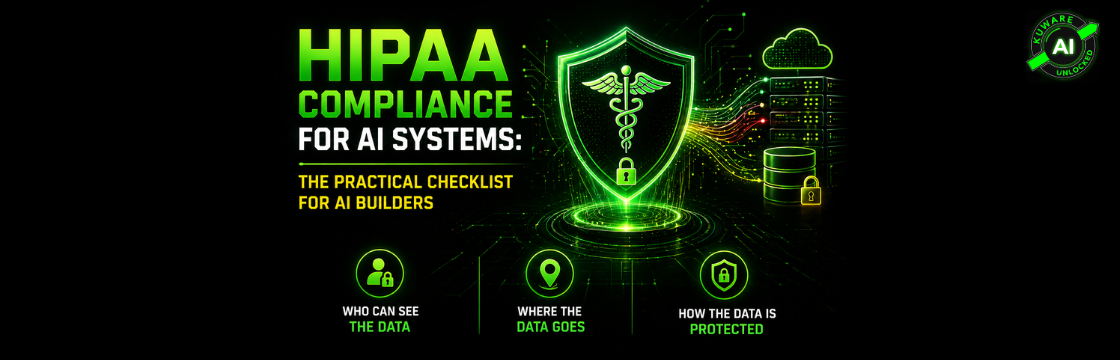
Control who can see the data, where it goes, and how it’s protected.
That’s it.
Everything else is just implementation details.
So instead of getting lost in legal language, I like to break it down into a working checklist.
The Real HIPAA Checklist for AI Systems
This is the version we actually use when thinking through builds.
Not theoretical. Practical.
1. Data in Transit (Are You Protecting It While It Moves?)
If your system is sending data between:
- Frontend → backend
- Backend → LLM API
- Backend → database
- Service → service
Then that data must be encrypted in transit.
In simple terms:
If you’re not using HTTPS with modern TLS (1.2+), you’re already in trouble.
Now here’s the nuance people miss:
Just because you’re calling an API doesn’t mean you’re automatically safe.
You need to verify:
- All endpoints enforce HTTPS
- No fallback to insecure protocols
- Internal services also use secure communication
If you’re serious about compliance, you don’t assume. You confirm.
2. Data at Rest (What Happens When Data Just Sits There?)
This is where most teams get sloppy.
“Yeah yeah, we’re secure, we use API keys.”
No.
API keys control access. They do not encrypt data.
If someone got a raw dump of your database or disk,
they still cannot read the data without a key.
Think:
- Database encryption (AES-256 typically)
- Encrypted file storage
- Encrypted backups
And yes, this applies to:
- SQL databases
- Object storage (S3, etc.)
- Vector databases
- Logs
If PHI touches it, it must be protected.
3. Access Control (Who Can See What?)
This is the “need-to-know” principle.
And honestly, this is where most real-world breaches happen.
You need:
- Role-based access (RBAC)
- Least privilege access
- Strong authentication (ideally MFA)
Example:
Your developer does not need access to production patient data.
Your support rep should not see full records.
Your support rep should not see full records.
Simple idea. Hard discipline.
4. Audit Logs (Can You Prove What Happened?)
If something goes wrong, HIPAA expects you to answer:
Who accessed what?
When?
From where?
When?
From where?
So you need:
- Access logs
- API logs
- Admin action logs
And not just storing logs…
You need to retain and monitor them.
You need to retain and monitor them.
No logs = no visibility = no defense.
5. Vendor Risk (This Is the Big One With AI)
This is where things get uncomfortable.
If you are using:
- LLM APIs
- Cloud providers
- Vector databases
- Logging tools
Then they are touching your data.
Which means they are your Business Associates.
And that means:
- You need a BAA (Business Associate Agreement)
- You need to verify their HIPAA posture
- You need to understand what they do with your data
Here’s the blunt truth:
Not all AI providers are HIPAA-ready.
And if they’re not, you cannot just “be careful” and still claim compliance.
Doesn’t work like that.
6. Data Minimization (Don’t Send What You Don’t Need)
This is underrated.
Just because your system can send full patient data to an LLM doesn’t mean it should.
Better approach:
- Strip unnecessary identifiers
- Mask sensitive fields
- Use tokens or IDs instead of raw data
Less data exposed = less risk.
Always.
7. Training and Internal Discipline
This is the boring part.
Also the part that breaks everything if ignored.
You need:
- Staff training on PHI handling
- Clear internal policies
- Defined processes for access and escalation
Because your system can be perfect…
…and one careless employee can undo all of it.
8. Breach Response (What Happens When Something Goes Wrong?)
And something will go wrong at some point.
So you need:
- Incident response plan
- Breach notification process
- Defined timelines and responsibilities
HIPAA doesn’t expect perfection.
But it absolutely expects preparedness.
Where Most AI Teams Get This Wrong
Let me call this out directly.
They think:
“We’re using a secure API, so we’re fine.”
No.
Or:
“Our vector database needs a key, so it’s protected.”
Also no.
Or:
“The LLM provider is big, so they must be compliant.”
Dangerous assumption.
The Reality
HIPAA compliance is not about one tool.
It’s about:
- How data flows
- Where it is stored
- Who can access it
- And whether you can prove control
Across your entire system.
One More Thing (This Matters for Your Business)
If you’re offering AI consulting or building systems for clients, this is not just a technical issue.
It’s a trust issue.
Clients don’t care about your architecture diagram.
They care about:
“Is my data safe?”
“Am I exposed?”
“Am I exposed?”
And this is where positioning matters.
If you can confidently walk them through this checklist,
you’re not just a developer anymore.
you’re not just a developer anymore.
You’re a partner.
That’s exactly how we position it in our consulting approach — practical, ROI-driven, and grounded in real systems, not theory .
What’s Next
This was Part 1.
The foundation.
- Which AI tools support HIPAA
- Which ones don’t
- What to watch out for with LLM APIs
- Real stack recommendations
Because that’s where this gets really actionable.
