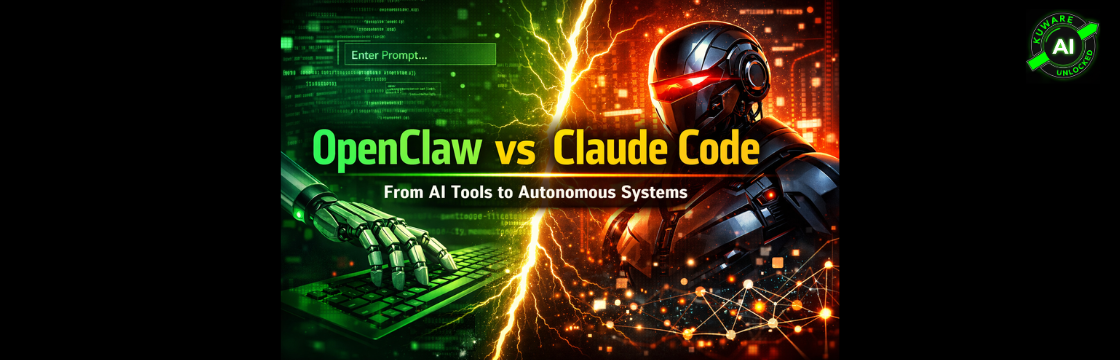
I’ve been watching the OpenClaw vs Claude Code conversation blow up over the last few weeks. And honestly, most people are missing the point.
They’re arguing features.
But this isn’t a feature debate. It’s an architecture shift. And once you see it, you can’t unsee it.
If you look under the hood, the difference becomes even clearer when you examine how execution loops, memory models, and system architecture actually behave in practice.
The moment AI stopped waiting for you
For a long time, AI tools behaved like very smart interns.
You asked. They answered.
You prompted. They responded.
You stayed in control.
You prompted. They responded.
You stayed in control.
That’s where tools like Claude Code still sit today. Incredibly powerful, especially for developers. It can understand massive codebases, refactor systems, even coordinate complex workflows.
But here’s the thing.
It still waits for you.
It still waits for you.
And OpenClaw doesn’t.
That one difference? It changes everything.
What actually makes OpenClaw different
When I first dug into OpenClaw, it didn’t feel like another AI tool. It felt like something… alive in the system.
Not in a sci-fi way. In a runtime way.
It runs continuously.
It remembers.
It acts without being asked every single time.
It remembers.
It acts without being asked every single time.
You can message it like a person. From WhatsApp. From iMessage. From wherever you are. And it doesn’t just respond. It does things on your machine.
Check your inbox.
Update your calendar.
Run a workflow.
Fix something while you’re asleep.
Update your calendar.
Run a workflow.
Fix something while you’re asleep.
That’s not “better prompting.”
That’s agency.
And that’s the real divide here.
The illusion most people fall for
A lot of people say:
“Yeah but with enough tools, skills, plugins… Claude Code can do the same things.”
On the surface, that sounds right.
And technically… it kind of is.
But only in the same way that saying:
“A human can build a factory, so a human is a factory.”
It misses the point completely.
The weird, almost philosophical twist
Here’s where it gets interesting. And honestly, a little mind-bending.
OpenClaw was originally built using Claude.
Let that sink in for a second.
The system that now represents autonomous AI behavior… was created using a tool that doesn’t have that autonomy.
So yes, you can argue:
Claude Code can do everything OpenClaw can do… because it literally created it.
And that’s true. In a very specific, almost philosophical sense.
But here’s the catch.
Creating something and being that thing are not the same.
Claude helped build the system.
OpenClaw is the system.
OpenClaw is the system.
That’s the difference between:
- intelligence
- and intelligence with agency
And that gap is where everything is happening right now.
Why this matters outside of dev circles
If you’re a developer, this is fascinating.
If you run a business? This is urgent.
Because most companies today are still operating in “Claude mode.”
They’re using AI like a tool:
- write content
- generate ideas
- maybe automate a few steps
But they’re still in the loop for everything.
Every decision. Every execution. Every follow-up.
It’s helpful. But it doesn’t change the game.
The shift we’re seeing in real businesses
What we’re starting to implement with clients looks a lot closer to the OpenClaw model.
Not the exact tool. The concept.
Systems that:
- run in the background
- trigger actions automatically
- connect multiple tools together
- remember context over time
- actually execute, not just suggest
Think:
A lead comes in → AI qualifies it → updates CRM → sends response → schedules follow-up → alerts your team only if needed.
No constant prompting. No babysitting.
That’s the difference between automation and agency.
And this is where most SMBs get stuck
They don’t lack tools.
They lack orchestration.
They’re trying to squeeze autonomous outcomes out of non-autonomous systems. And then wondering why it feels clunky.
It’s like hiring a brilliant strategist… and then forcing them to ask permission for every single move.
You don’t get leverage that way.
The real takeaway
This isn’t about OpenClaw vs Claude Code.
It’s about a bigger question:
How much control are you willing to give your systems?
Because that’s the tradeoff.
More control → more safety, more oversight
More autonomy → more leverage, more output
More autonomy → more leverage, more output
And every business is going to land somewhere on that spectrum.
Where Kuware fits into this
Most of the companies we work with aren’t trying to build bleeding-edge agent systems from scratch.
They just want results.
More leads.
Faster operations.
Less manual work.
Faster operations.
Less manual work.
That’s why our approach is simple:
- AI Assessment → where can autonomy actually create value
- AI Implementation → build systems that don’t need constant input
- Training & Support → make sure your team isn’t overwhelmed
Because guessing with AI gets expensive fast.
But done right, it compounds.
But done right, it compounds.
One last thought
We’re moving from a world where AI helps you work…
to a world where AI does the work with you…
and very soon, a world where AI does the work for you.
to a world where AI does the work with you…
and very soon, a world where AI does the work for you.
The technology is already here.
The only real question left is:
Are you still prompting…
or are you building systems that act?
or are you building systems that act?
If you’re not sure where your business stands right now, start there.
Because the gap between those two worlds is where the opportunity is.
And it’s growing fast.
Unlock your future with AI. Or risk being locked out.
