Most of the conversations around OpenClaw vs Claude Code right now feel… a bit surface-level.
People are throwing around terms like “agents,” “automation,” “autonomy” like they all mean the same thing. They don’t. And if you’re actually trying to build something real, those differences matter a lot.
So let’s slow this down and look at it properly. Not hype. Not philosophy. Just how these systems actually behave under the hood.
First, you need to understand the architecture gap
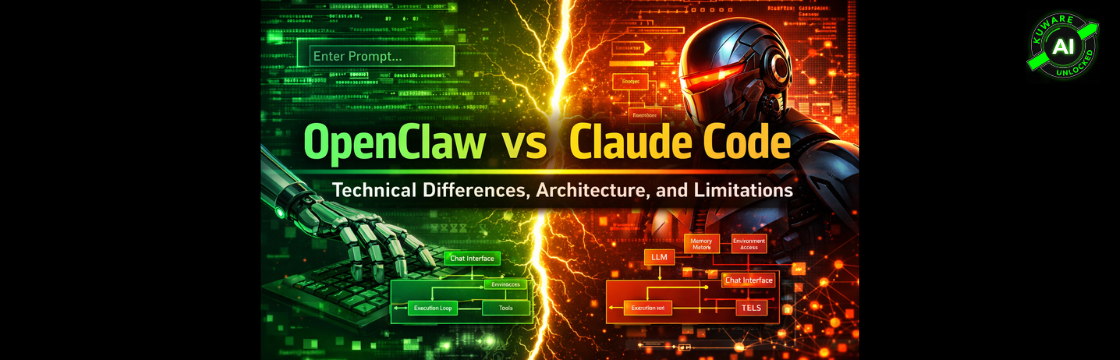
At a high level, both systems use LLMs. That’s where the similarity ends.
Claude Code is fundamentally:
LLM + tools + human control loop
OpenClaw is:
LLM + tools + execution loop + memory + environment access
That extra layer changes everything.
Because once you introduce an execution loop and persistent state, you’re no longer dealing with a tool. You’re dealing with a system.
Execution model: request-response vs continuous loop
This is the biggest difference. And honestly, the one most people underestimate.
Claude Code works in a request-response cycle:
- user gives instruction
- model plans
- tools execute
- user approves or iterates
Everything is bounded by a session.
OpenClaw runs a continuous loop:
- check state
- decide next action
- execute
- update memory
- repeat
No prompt required after initialization.
That means OpenClaw can:
- monitor systems
- trigger actions on conditions
- continue long workflows without intervention
Claude Code cannot do this natively. Even with scheduled tasks, it’s still dependent on an active environment and triggers, not a true autonomous loop.
This shift from bounded interaction to continuous execution is part of a broader transition toward AI systems that operate with agency rather than waiting for prompts.
Memory: ephemeral vs persistent state
Claude Code has improved memory. But let’s be honest about what it is.
It’s context management, not true memory.
- session-bound
- compacted over time
- partially retained
You lose continuity across environments or over long periods unless you manually structure it.
OpenClaw treats memory as a first-class system component:
- stored in local files
- editable by the user
- persistent across restarts
- structured (identity, preferences, history, skills)
From a systems perspective, this is closer to a database than a prompt.
And that’s why it behaves consistently over time.
Tooling vs orchestration
Claude Code is extremely strong at tool usage.
It can:
- call APIs
- edit codebases
- run commands
- coordinate multi-step tasks
But each task is still bounded.
OpenClaw introduces orchestration at the system level:
- chains tasks across applications
- maintains state between steps
- reacts to outcomes dynamically
Example difference:
Claude Code:
“Write script → run → check output → suggest fix”
OpenClaw:
“Monitor repo → detect issue → fix → test → deploy → notify”
One is execution. The other is process ownership.
Environment access and constraints
This is where the limitations become very real.
Claude Code:
- operates inside a controlled environment
- subject to platform guardrails
- limited OS-level autonomy
- cloud-dependent for intelligence
OpenClaw:
- full local system access (optional but common)
- interacts with real-world apps (email, calendar, messaging)
- can run on local models
- no enforced guardrails beyond what you implement
From an engineering perspective, this is the difference between:
- a sandboxed runtime
- and a host-level agent
And yes, that comes with tradeoffs.
Autonomy and control boundaries
Let’s be precise here.
Claude Code is designed for:
- reliability
- predictability
- human oversight
It intentionally avoids full autonomy.
OpenClaw is designed for:
- independence
- continuity
- minimal human intervention
It intentionally enables autonomy.
So when people ask:
“Why doesn’t Claude Code just do what OpenClaw does?”
The answer is simple.
It’s not supposed to.
Model flexibility and cost implications
Claude Code is tightly coupled to Anthropic models.
That means:
- high-quality reasoning
- consistent behavior
- but ongoing cost and API dependency
OpenClaw abstracts the model layer.
You can plug in:
- Claude
- GPT
- local models
- cheaper alternatives
And switch dynamically.
From a systems design perspective, this is massive.
It turns the LLM into a replaceable component, not a dependency.
Where Claude Code still wins
Now, to be fair. And this part matters.
Claude Code is still superior in:
- deep codebase understanding
- structured reasoning
- safe execution environments
- enterprise readiness
If you’re doing serious software engineering work, it’s incredibly effective.
OpenClaw isn’t trying to beat it there.
Where OpenClaw pulls ahead
OpenClaw wins when the problem is:
- ongoing
- multi-system
- real-world
- asynchronous
Anything that benefits from:
- persistence
- autonomy
- cross-tool coordination
That’s its territory.
The limitation no one talks about
Here’s the uncomfortable truth.
Neither system is complete.
Claude Code lacks autonomy.
OpenClaw lacks guardrails and reliability at scale.
So what are people actually doing?
They’re combining them.
Using Claude as the reasoning engine
inside systems like OpenClaw for execution
inside systems like OpenClaw for execution
And that hybrid model? That’s where things get interesting.
What this means for real implementations
If you’re building systems today, the decision isn’t:
“Which tool is better?”
It’s:
“Where do I need control, and where do I need autonomy?”
For most businesses, the answer is:
- controlled AI for critical decisions
- autonomous systems for execution and operations
That balance is where ROI actually shows up.
Bringing this back to Kuware
This is exactly the gap we see with clients.
They’re using powerful tools. But they’re stuck in isolated workflows.
No persistence.
No orchestration.
No real autonomy.
No orchestration.
No real autonomy.
That’s where we step in:
- AI Assessment → identify where systems break down
- AI Implementation → build connected, executing workflows
- Training & Support → make it usable, not overwhelming
Because the goal isn’t to adopt tools.
It’s to build systems that actually run.
Final thought
The industry keeps asking:
“What can this model do?”
The better question is:
“What kind of system is this model part of?”
Because the future isn’t about better prompts.
It’s about better architectures.
And right now, that’s where the real gap is.
Unlock your future with AI. Or risk being locked out.
