
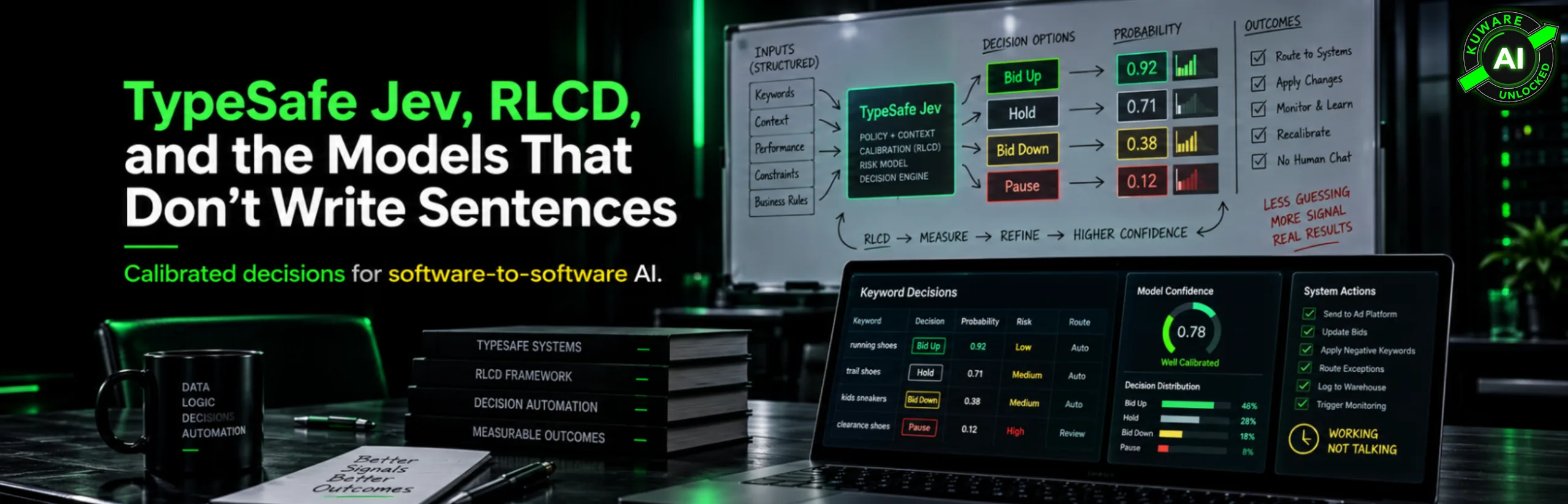
TypeSafe and its new AI model, Jev, are suddenly getting a lot of attention in AI circles.
But what exactly is Jev?
What is RLCD?
And why would anyone need another kind of AI model when ChatGPT, Claude, Gemini, and the rest can already answer questions, reason, write code, and return structured data?
The simplest answer is this:
Jev is not primarily designed to talk to you. It is designed to make decisions for software.
Instead of asking it to write a paragraph, you might give it a set of Google Ads data and ask about keyword Bidding:
Should we:
Bid up?
Hold?
Bid down?
Pause?
Jev returns the choice along with probabilities.
That is where RLCD, Reinforcement Learning for Calibrated Decisions, comes in.
The idea behind RLCD is not just to teach an AI model to make the right decision.
It is also to teach the model to be more honest about how confident it should be in that decision.
If a model says it is 80% confident across hundreds of similar decisions, you would ideally expect it to be right roughly 80% of the time.
That sounds simple.
It is actually a pretty important change in how we might use AI inside business software.
We are currently on the waiting list for access to Jev.
In the meantime, we have been experimenting with Laya, another open-weight AI model built around the same general idea of typed decisions and calibrated probabilities.
So instead of treating RLCD, Jev, Laya, and System One models as another pile of AI jargon, let’s demystify what these terms mean and, more importantly, where they might actually be useful in a business.
Because this is still very early.
And early is exactly when it is worth separating the useful idea from the hype.
What Is TypeSafe Jev?
TypeSafe AI introduced Jev in September 2026 as its first public System One Model.
Let’s simplify that term first.
A traditional large language model usually works by generating one token after another. That is why ChatGPT or Claude can write sentences, paragraphs, code, reports, and conversations.
Jev is designed for a different job.
You give it information about a situation, then ask it a structured question.
Instead of generating a long response, it gives you a typed decision.
For example:
State: Google Ads keyword performance
Question: What action should we take?
Possible answers:
Bid up
Hold
Bid down
Pause
The model might return:
Bid up: 0.12
Hold: 0.18
Bid down: 0.24
Pause: 0.46
Now ordinary software can do something with that.
Maybe your rule says:
If the probability of “Pause” exceeds 90%, pause automatically.
If it falls between 70% and 90%, send it to a human.
Below 70%, take no action.
That is very different from asking a chatbot:
“What do you think we should do with this keyword?”
and receiving four paragraphs of analysis that another program then has to interpret.
What Does "System One Model" Mean?
This term comes from the distinction between fast and slow thinking.
You do not need the psychology lesson to understand the AI version.
A System One model is meant to make a relatively fast decision from the information in front of it.
It is not supposed to spend a long time reasoning through a complicated problem and explaining every step.
Think:
Recognize. Score. Decide.
Not:
Research. Reason. Write an essay.
That distinction matters because a lot of business automation does not need another AI conversation.
Software needs a decision.
Route this ticket.
Flag this transaction.
Approve this request.
Escalate this customer.
Pause this keyword.
Choose option A, B, C, or D.
That is the basic territory Jev is trying to occupy.
So What Is RLCD?
RLCD stands for Reinforcement Learning for Calibrated Decisions.
There are two ideas hidden inside that phrase.
First, reinforcement learning.
In plain English, reinforcement learning means you train a model by rewarding behavior you want and penalizing behavior you do not want.
The second idea is calibration.
Calibration asks whether the model’s confidence matches reality.
Imagine a weather forecast.
If a meteorologist says there is a 70% chance of rain on 100 different days, you would expect rain on roughly 70 of those days.
That forecaster would be well calibrated.
Now apply the same idea to an AI model.
If the model makes 100 decisions with approximately 90% confidence, we should expect roughly 90 of them to be correct.
That is what makes the probability useful.
Without calibration, a model saying “0.93 confidence” may simply be producing a number that looks authoritative.
With good calibration, that number starts becoming something software can actually use.
RLHF, RLVR, and RLCD
The easiest way to understand RLCD is to compare it with two other reinforcement-learning approaches that have shaped modern AI.
RLHF: What Do Humans Prefer?
RLHF means Reinforcement Learning from Human Feedback.
The idea became important in modern language models through work beginning years before ChatGPT.
Humans compare model responses.
Maybe Response A is better than Response B.
The system learns from those preferences.
In very simple terms:
RLHF asks: Which answer do people prefer?
This helped turn raw language models into assistants that respond more usefully to human instructions.
RLVR: Can We Check Whether the Answer Is Right?
RLVR means Reinforcement Learning with Verifiable Rewards.
The phrase sounds complicated, but the idea is straightforward.
Some answers can be checked automatically.
A math problem has an answer.
A programming test either passes or fails.
A puzzle may have a known solution.
So instead of asking a human whether the answer looks good, software can verify the result.
In simple terms:
RLVR asks: Can we objectively check whether the answer is correct?
This approach became especially important in reasoning models.
RLCD: Does the Confidence Match Reality?
RLCD pushes the reward toward something slightly different.
RLCD asks: Is the model honest about how likely it is to be correct?
That distinction matters.
Suppose two models both choose the same answer.
Model A says:
Probability: 99%
Model B says:
Probability: 72%
Then the answer turns out to be wrong.
If this pattern repeats frequently, Model A is badly overconfident.
Model B may actually be much better calibrated.
For autonomous software, that difference can matter as much as the answer itself.
Jev Has Closed Weights. Laya Does Not.
While we wait for access to Jev, we have been experimenting with Laya.
Laya comes from Convai Innovations and Nandakishor Mukkunnoth in Kerala, India.
It attacks a similar class of problem.
You give the model information.
You define the kinds of answers you will accept.
The model returns a decision and probabilities instead of writing a long response.
One major difference is accessibility.
Jev’s model weights are not openly available.
Laya is released under the Apache 2.0 license, which means developers can download and run the model themselves.
That matters to us because it means we can experiment locally instead of waiting for a hosted service.
The current Laya family includes an English model built on ModernBERT-large, a smaller multilingual model, and a specialist model tuned more directly for typed decisions.
The English checkpoint is about 421 million parameters.
That is relatively small by today’s AI standards.
And that is part of what makes this category interesting.
You may not need a massive frontier language model to answer:
Pause or hold?
Approve or escalate?
High risk or low risk?
Laya Lets Us See More of the Training Recipe
Because Laya is open, we can inspect more of how it approaches RLCD.
This is where the terminology starts getting more technical, so here is the simple version first.
The training system tries to make lying about confidence expensive.
If the model genuinely believes something has a 70% probability, the reward system should encourage it to report something close to 70%, not exaggerate that into 98%.
The mathematical tools used to do that are called proper scoring rules.
That phrase sounds worse than it is.
A proper scoring rule is simply a way to reward probability forecasts so that the best strategy is to report your real belief.
Laya documents the use of scoring methods including log score, spherical score, and ranked probability score for ordered decisions.
You do not need to understand those equations to understand the purpose.
They are trying to reward:
Good decision plus honest confidence.
Not merely:
Good decision.
Laya also adds controlled randomness during training so the model explores alternatives instead of locking too quickly onto one answer.
Again, the implementation is technical.
The business idea is not.
The model should not just tell us what it thinks.
It should give us a probability we can eventually test against reality.
But RLCD Does Not Magically Make a Model Trustworthy
This needs to be very clear.
Training a model for calibration does not prove that the model will be calibrated on your business.
You still have:
Bad data.
Unusual cases.
Changing environments.
Weak labels.
Model limitations.
Training limitations.
Different customer populations.
Different languages.
Different industries.
A probability coming out of the model is still something that needs to be measured.
That is why we are interested in RLCD, but we are not treating it as magic.
Calibration Is Not the Same Thing as Accuracy
This distinction is easy to miss.
Suppose a model is right 70% of the time.
If it consistently says:
“I’m about 70% confident”
it may be very well calibrated.
But a 70% accurate model might still be completely unacceptable for your application.
You probably do not want an AI autonomously approving large financial transactions if it is wrong 30% of the time.
Now imagine another model that is right 95% of the time but constantly reports 99.99% confidence.
That model might be highly accurate but poorly calibrated.
If your software trusts that 99.99% number, the remaining errors could become dangerous.
So we really care about two separate questions.
Was the model right?
And:
Did its confidence accurately represent the chance that it was right?
For automated systems, both matter.
What Is Temperature Scaling?
Another technical term you will see around these models is temperature scaling.
Again, the simple explanation first.
Sometimes a model picks the correct answer but sounds far too confident about it.
Temperature scaling adjusts those probabilities after training.
For example, a model might originally say:
Pause: 98%
Hold: 1%
Bid down: 1%
After calibration it might say:
Pause: 76%
Hold: 15%
Bid down: 9%
The preferred answer did not change.
Pause is still the model’s first choice.
What changed was how confident the model claimed to be.
For a human reading the answer, that might not matter much.
For software that automatically pauses campaigns above a 90% threshold, it matters enormously.
That is why Laya’s own documentation recommends calibrating and evaluating the model on your own data.
That is what we intend to do.
Jev Needs the Same Skepticism
The same standard applies to TypeSafe.
A vendor can report excellent calibration numbers.
That is useful.
It is not enough.
Early independent Jev testing already shows why.
One small benchmark involving tool-call risks reported encouraging calibration results.
Another larger phishing-email experiment produced much weaker results for Jev’s direct verdict.
Interestingly, the phishing experiment found that Jev performed much better when the overall problem was broken into smaller, more specific questions.
That may turn out to be an important design lesson.
Instead of asking:
“Is this email phishing?”
you might ask smaller questions such as:
Does the sender domain match?
Is the request unusually urgent?
Does the link destination differ from the visible domain?
Is the email asking for credentials?
Then combine those signals.
In other words, the model architecture matters.
But so does the way we structure the decision.
Why Not Just Use ChatGPT, Claude, or Gemini?
This is probably the most practical question.
Modern general-purpose models already support structured output.
You can ask them:
Choose exactly one:
Bid up
Hold
Bid down
Pause
And return valid JSON.
That works.
In many cases, it works very well.
So the key advantage of RLCD is not simply structured output.
The interesting part is calibrated probability.
Imagine asking a general LLM to return:
					{
  "decision": "pause",
  "confidence": 0.93
}
The JSON may be perfectly valid.
The decision may even be good.
But what does 0.93 actually mean?
Was the model trained so that predictions with 93% confidence are correct approximately 93% of the time?
Maybe.
Maybe not.
You cannot assume it simply because the model produced a confidence field.
That is the problem RLCD is trying to solve more directly.
Our First Practical Test: Google Ads
We do not want to evaluate this category only with synthetic benchmarks.
Our first serious experiment is much closer to home.
Google Ads.
We already have large amounts of structured advertising data.
For a keyword we may know things such as:
Clicks
Cost
Conversions
Conversion value
Cost per conversion
Match type
Recent trend
Historical trend
Search behavior
The obvious question is:
Can an RLCD-style model help decide what to do next?
Our initial action set is intentionally simple:
Bid up.
Hold.
Bid down.
Pause.
Give the model the keyword state.
Get back a probability distribution.
Then log what it recommends.
At first, it does nothing.
No live bid changes.
No automatic pausing.
We watch.
There Is a Complication With Historical Data
At first glance, Google Ads looks like an ideal training environment because we have years of outcomes.
But there is a subtle problem.
We know what happened after the action we actually took.
We do not know exactly what would have happened if we had taken one of the other actions.
Suppose we held a keyword.
We know what happened next.
But what would have happened if we had increased the bid?
Or decreased it?
Or paused it?
We cannot observe all four alternate realities.
This is called a counterfactual problem.
Simple explanation:
We can observe what happened. We cannot directly observe what would have happened if we had made a different decision.
That means historical outcomes are useful, but they do not automatically give us perfect labels for:
“The correct action should have been Bid Down.”
So we need to design the experiment carefully.
How We Plan to Test It
First, the model can only see information that existed at the time of the decision.
This avoids data leakage.
Data leakage simply means accidentally showing the model information from the future and then congratulating it for predicting something it had effectively already seen.
Second, we split historical data by time.
Older periods help us calibrate or develop the system.
Later periods test it.
That is closer to how the model would actually experience the world.
Third, we can ask some questions where the future outcome is easier to measure.
For example:
What is the probability that this keyword remains above our target CPA during the next evaluation period?
That question gives us something measurable.
We can then separately decide what business action should follow.
That keeps two problems apart:
What is likely to happen?
and
What should we do about it?
Those are not always the same question.
Shadow Mode Comes Before Automation
Our first live phase will be shadow mode.
That means the model gets the same data it would receive in production.
It makes decisions.
We record them.
But the model does not control the account.
We compare Laya’s recommendations with our existing rules, human decisions, and eventual outcomes.
Then we can ask useful questions.
When Laya says 90%, is it actually right about 90% of the time?
Where does it disagree with us?
When it disagrees, who is right?
Does accuracy improve as confidence rises?
How many decisions could we safely automate if we required a very high confidence threshold?
Those answers are more interesting to us than a benchmark score.
The Threshold Should Depend on the Cost of Being Wrong
There is another mistake we want to avoid.
Suppose the model says:
Pause: 81%
Should it automatically pause the keyword?
There is no universal answer.
It depends on what being wrong costs.
A false “hold” may cost a little advertising spend.
A false “pause” could shut down a profitable keyword.
Those errors are not equally expensive.
So instead of saying:
“Anything over 80% runs automatically”
the system might eventually use different thresholds for different actions.
Maybe high-risk actions require 98%.
Low-risk actions might run at 90%.
Medium-confidence decisions go to human review.
The correct threshold is an economic decision, not an AI number.
When We Get Jev Access, We Run the Same Test
When our Jev access arrives, we plan to give it the same experiment.
Same historical rows.
Same information.
Same questions.
Same scoring.
Same shadow environment.
Then we can finally ask interesting questions.
Do Jev and Laya agree?
When they disagree, which model performs better?
Are their probabilities actually calibrated?
Does one model perform better on certain kinds of decisions?
How much work can either system safely automate before the cost of errors becomes unacceptable?
That is much more useful than asking which model “wins.”
Why Open Weights Matter With Laya
One thing we already like about Laya is that we can run it ourselves.
The model is released under Apache 2.0.
That means we can experiment locally and keep control over the infrastructure.
For something connected to advertising spend, that is attractive.
But open weights do not automatically make a model good.
Laya’s own documentation describes weaknesses.
Larger sets of choices can hurt performance.
Different model variants perform differently.
The English model can sometimes remain confident even when it receives language it does not understand well.
That last problem is especially important.
A model can be confidently wrong even when it encounters something outside the world it was designed for.
Which brings us to one of the larger problems with automated AI systems.
Computers Talking to Computers
Most people still experience AI as a conversation.
Human asks question.
AI answers.
But a huge amount of future AI activity may happen without a human sitting there reading the response.
Software calls software.
An agent pulls information from a CRM.
Another system checks policy.
Another model evaluates risk.
Then something has to decide what happens.
This is where things like MCP become relevant.
MCP, or Model Context Protocol, helps AI systems connect to tools and data.
But connecting the tool only gets us so far.
Suppose an AI can retrieve a customer’s history.
Great.
Now what?
Approve the refund?
Escalate it?
Ask for additional documentation?
Reject it?
The system does not necessarily need 500 words of explanation.
It needs a decision.
And it needs to know whether the decision is confident enough to act automatically.
That is where RLCD-style models could become important.
The Composition Problem
Now things get more complicated.
Imagine one model determines whether a request looks fraudulent.
Its answer becomes input to another model deciding whether to freeze an account.
That answer goes to another system deciding whether to refund money.
This is called composition.
Simple explanation:
Several AI decisions get chained together to produce one final outcome.
The problem is that good calibration in each model does not guarantee good calibration for the whole chain.
A 90% probability from one system does not magically remain 90% after it passes through several other decisions.
Errors can accumulate.
One model can filter which cases another model sees.
The difficult cases may get concentrated downstream.
Two models may make correlated mistakes.
So if calibrated decision models eventually become infrastructure, companies will need to evaluate complete workflows, not just individual model benchmarks.
Then the Real World Changes
There is another problem called distribution shift.
Simple explanation:
The world the model was trained on stops looking like the world the model is operating in.
Google Ads is a perfect example.
Auction behavior changes.
Competitors change.
Seasonality changes.
Landing pages change.
Conversion tracking changes.
Customer behavior changes.
Google changes the platform itself.
The model can still confidently output:
0.96
But the environment behind that number may have changed.
That means calibration cannot be something you test once.
You have to keep measuring it.
And Sometimes People Try to Fool the Model
For some applications, there is also an adversarial problem.
Someone may intentionally create an input designed to influence the decision.
A customer can word a refund request strategically.
A scammer can manipulate an email.
Someone requesting access can make a dangerous action appear harmless.
For Google Ads keyword decisions, this is not our biggest concern.
For money movement, security, access control, refunds, or permissions, it matters a lot.
And this is why traditional software rules do not disappear.
The AI might decide:
“This refund looks legitimate.”
But deterministic code can still say:
“The AI can never automatically approve more than $500.”
That combination may be much safer than giving the model unlimited authority.
What Would Make Us Trust an RLCD Model?
Not the acronym.
Not the vendor benchmark.
Not the fact that the model printed 0.973.
We want to know whether that number survives contact with our data.
If the model makes 500 decisions at roughly 90% confidence, how often is it actually correct?
If we increase the automation threshold, does error rate drop?
Where does the model fail?
Does it perform differently across campaigns?
Does performance change over time?
How often does it see something outside its normal data distribution?
What does a wrong decision cost?
Those are the questions that determine whether the model belongs in production.
Why We Think This Category Is Worth Watching
RLCD is still an extremely new public term.
Jev is new.
Laya is new.
The benchmarks are early.
The deployment patterns are still being figured out.
That is too early to declare RLCD the next major AI paradigm.
But the underlying idea makes a lot of sense.
We have spent years building increasingly capable AI models that can talk.
Now we are beginning to ask a different question:
What if the software does not need another sentence?
Sometimes it just needs:
Yes or no.
Route A or Route B.
Approve or escalate.
Bid up or pause.
And if the AI is going to make that decision, the probability attached to the answer needs to mean something.
That is the part of RLCD we find interesting.
We are not giving Laya control of live Google Ads accounts yet.
We are testing.
When Jev access arrives, we will test that too.
Then the models can earn the right to do more.
Not because the demo looks impressive.
Because the numbers hold up.
Interested in exploring innovative AI solutions for your business problems? Let’s talk.
