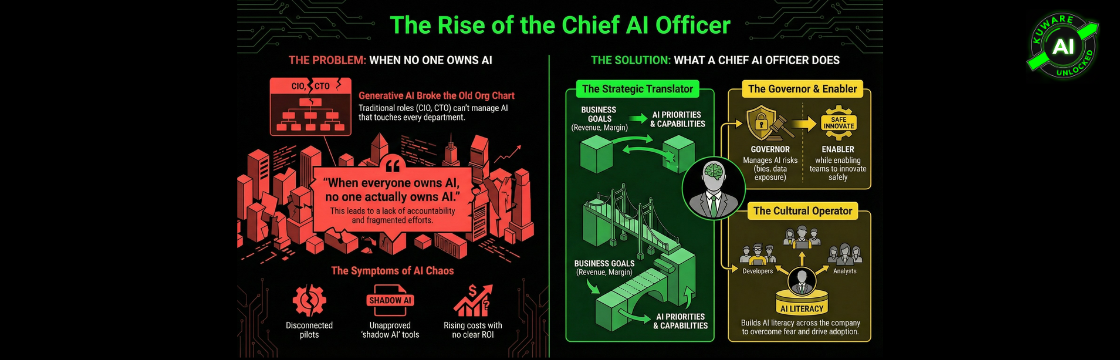
A Chief AI Officer (CAIO), also known as a Chief Artificial Intelligence Officer, is a senior executive responsible for overseeing an organization’s artificial intelligence strategy, development, and implementation. This role serves as a bridge between technical execution and business outcomes, ensuring that AI technologies are aligned with the organization’s long-term goals while managing the unique risks associated with AI adoption.
The following sections detail the core functions, strategic importance, and qualifications of a CAIO based on the provided sources.
Core Roles and Responsibilities
The CAIO is typically the highest-ranking AI executive, often collaborating with or sitting alongside other C-suite leaders like the Chief Information Officer (CIO) and Chief Data Officer (CDO). Their mandate covers several critical areas:
- Strategic Alignment and Vision: The CAIO is responsible for crafting and executing a comprehensive AI strategy that supports business objectives. They act as a visionary, identifying opportunities where AI can add value, such as revenue enhancement, cost reduction, or customer experience improvement.
- Governance, Ethics, and Compliance: A primary duty is ensuring that AI initiatives are “legally, ethically, and morally sound”. This involves setting guidelines for privacy, fairness, and transparency to prevent bias and ensure algorithmic safety. With regulations like the EU AI Act and the U.S. Executive Order 14110, the CAIO must also ensure the organization remains compliant with evolving laws.
- Cross-Functional Collaboration: To prevent AI efforts from becoming siloed, the CAIO orchestrates collaboration between IT, operations, legal, marketing, and HR. They ensure that AI solutions are integrated holistically across the enterprise rather than remaining isolated experiments.
- Cultural Transformation and Literacy: The CAIO acts as a cultural leader, tasked with embedding an AI-literate culture within the firm. This includes overseeing upskilling programs, managing workforce resistance, and demystifying AI for stakeholders and employees.
- Technology and Innovation: While they may not code every day, CAIOs must stay ahead of the “breakneck pace” of AI advancements. They work with the Chief Technology Officer (CTO) to deploy infrastructure and select appropriate technologies.
The Rise of the CAIO
The position has seen exponential growth, with the number of CAIOs participating in forums increasing by over 540% between 2022 and 2023. This surge is driven by the rapid adoption of generative AI and the need for accountability in deploying these powerful tools.
Government Mandates: The role has been formalized significantly within the U.S. federal government. Executive Order 14110, signed by President Biden in October 2023, mandated that major federal agencies appoint a Chief AI Officer to coordinate the safe and secure use of AI.
CAIO vs. Chief Data Officer (CDO)
While the roles are symbiotic, there is a distinct difference between a CAIO and a CDO:
- The CDO focuses on data governance, quality, and infrastructure, treating data as a strategic asset. Their vision is often broad and long-term, ensuring the “fuel” (data) is reliable and compliant.
- The CAIO focuses on the application and engine, how AI models are built and scaled to solve specific business problems. Their approach is often more dynamic, targeting competitive edges through immediate and mid-term AI solutions.
This distinction is clearer when viewed alongside the differences between the CAIO, CDO, and CIO in terms of accountability, time horizon, and AI ownership.
The CAIO Playbook: Strategy and Execution
Successful CAIOs often utilize a 90-day framework to establish their tenure, which includes:
- Learning and Assessment (Days 1–30): Assessing organizational readiness, AI literacy, and existing infrastructure.
- Strategic Planning (Days 31–60): Defining the vision, prioritizing use cases based on feasibility and impact, and building relationships with key stakeholders.
- Execution (Days 61–90): Launching pilot projects, establishing governance frameworks, and adjusting strategies based on early feedback.
Skills and Qualifications
The ideal CAIO blends technical expertise with “C-Suite gravitas”.
- Educational Background: Common foundations include degrees in Computer Science, Data Science, Mathematics, or Cognitive Science.
- Experience: Candidates often have backgrounds as Machine Learning Engineers, Data Scientists, or AI Research Scientists. Notable examples include Joëlle Pineau, a computer scientist who served as the VP of AI Research at Meta and later became the Chief AI Officer at Cohere.
- Key Competencies: Beyond technical skills, they must possess strategic vision, change management expertise, and the ability to explain complex technical concepts to non-technical stakeholders.
Arguments For and Against the Role
Reasons to Hire a CAIO:
- Ensures AI efforts are not siloed and facilitates cross-departmental collaboration.
- Allows the organization to move quickly in a fast-evolving market.
- Signals to investors and customers that the organization is innovative and cutting-edge.
Reasons Not to Hire a CAIO:
- Finding a single person with the requisite blend of business and technical skills (a “unicorn”) is difficult and expensive.
- The role might become redundant or integrated into the CIO/CTO roles over time, similar to how “Chief Internet Officers” disappeared after the 1990s.
- It may create friction with other executives if boundaries regarding territory and budget are not clear.
