
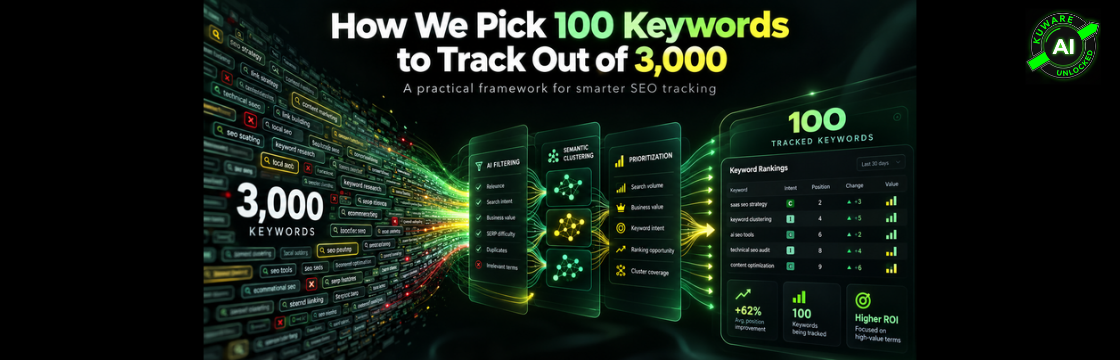
Why search volume alone is a terrible way to decide which keywords matter, and how AI can turn a complicated SEO process into a repeatable system.
Imagine running SEO for a plumbing company in Austin, Texas.
Your keyword research produces 3,000 potential search terms. Your rank-tracking subscription gives you room to monitor just 100.
Which 100 do you choose?
The obvious approach is to sort by search volume, keep the biggest keywords, and forget the rest.
That’s also a good way to waste your SEO budget.
A person searching for “how to fix a leaking faucet” might want a YouTube tutorial. Someone searching for “emergency plumber near me” probably wants a phone number.
But it gets more complicated.
Someone searching for “water heater leaking from bottom” might look like an informational search to an SEO tool. In reality, that person could be standing in a flooded garage, looking for someone who can fix the problem today.
And a relatively low-volume keyword for tankless water heater installation might represent significantly more business value than a popular keyword for a small plumbing repair.
So how do you decide what deserves one of those 100 tracking slots?
We use a framework built around four factors:
- Search demand: How often are people searching for it?
- Search intent: What are they actually trying to accomplish?
- Business value: How valuable is that service to the business?
- Ranking opportunity: How well does the website already perform, and what would it take to improve?
The interesting part is what happens when you combine those factors with AI, semantic clustering, SEO data, and a structured workflow.
You can move from thousands of keyword possibilities to a focused tracking system that your team can maintain without repeating the entire research process every month.
Here’s how the methodology works.
1. Start With One Consistent SEO Data Source
Before selecting keywords, make sure you’re comparing the same kinds of data.
For this workflow, we use SE Ranking as the primary research and ranking-data source.
It provides keyword search volume, cost-per-click (CPC), paid-search competition, keyword difficulty, search intent, historical trends, and rank-tracking capabilities.
Why not combine everything from Google Search Console, Google Ads, and multiple SEO platforms?
Because different tools measure different things.
Google Search Console tells you how your website actually performs in Google Search. It provides impressions, clicks, click-through rates, and average positions.
Google Ads Keyword Planner estimates search demand and provides advertising-related metrics.
Third-party SEO tools estimate keyword demand, ranking difficulty, and other competitive signals using their own data and methodologies.
All of these sources can be useful. But combining their numbers into a single scoring formula without normalization can produce misleading comparisons.
So we use one consistent dataset to select and prioritize keywords.
Then we use Search Console and business conversion data to validate whether the selected keywords actually produce meaningful traffic and leads.
One source for consistent keyword comparisons. Multiple sources for measuring business results.
That’s an important distinction.
2. Expand the Seed Keywords, Then Filter Conservatively
The starting point is the client’s service menu.
For a plumbing company, seed terms might include:
- Emergency plumbing
- Water heater repair
- Tankless water heater installation
- Drain cleaning
- Sewer line replacement
- Faucet repair
We typically start with 5 to 20 seed terms, depending on the number of services and the business’s geographic coverage.
Keyword expansion generates variations, including service phrases, location modifiers, question-based searches, and long-tail keywords.
It’s not difficult to turn that initial list into several thousand possibilities.
The next step is removing obvious mismatches.
For example:
- DIY tutorials from people who explicitly want to perform the work themselves
- Plumbing jobs, salaries, apprenticeships, and career searches
- Replacement parts and retail shopping searches
- Geographic locations outside the service area
- Services the company doesn’t offer or want to promote
But the important rule is this:
When in doubt, keep the keyword for human review.
Removing a valuable keyword too early means it never gets considered.
Keeping one questionable keyword simply means it gets reviewed later.
Every excluded keyword should also receive a reason code.
That makes the filtering process auditable. If someone later asks why “water heater troubleshooting” disappeared, the team can see whether it was excluded as DIY content, considered irrelevant, or removed for another reason.
An AI system shouldn’t quietly discard business opportunities without leaving a record.
3. Don't Let Search Intent Labels Make the Decision
Most SEO tools classify keywords using labels such as informational, commercial, transactional, local, and navigational.
These categories help, but they don’t always capture what a customer needs.
Consider:
“Water heater leaking from bottom”
An automated classifier might call this informational because it describes a problem rather than directly requesting a service.
But the business context matters.
A leaking water heater can create an immediate need for professional repair or replacement.
Compare that with:
“How does a tankless water heater work?”
Both searches involve water heaters. Their likely commercial urgency is very different.
This is where CPC and paid-search competition can provide additional clues.
If advertisers regularly compete for a problem-oriented keyword, there may be commercial value behind that search even when an SEO tool labels it informational.
But CPC is only a supporting signal.
A high CPC doesn’t prove that a keyword produces profitable customers. Advertising bids also reflect competition, campaign strategy, and what individual advertisers are willing to spend.
And paid-search competition is not the same as organic SEO difficulty.
The approach is to flag potentially valuable informational keywords for review rather than automatically throwing them away.
Intent classifications should inform business judgment, not replace it.
Watch for bad search-volume data
Search-volume estimates also need basic quality control.
Suppose a historical export shows “plumber near me” receiving 550,000 to 673,000 searches across earlier months, but the latest month shows only 2,900.
You shouldn’t conclude that demand suddenly collapsed.
First, verify that the reporting period, location, units, source database, and metric definitions are consistent.
If the latest month is incomplete or clearly anomalous, exclude it from the comparison and use the median of reliable historical months as a working baseline.
The median is often more robust than the mean when individual months contain extreme values.
However, don’t flatten real seasonal trends just because they complicate the calculation.
A heating contractor, for example, may experience genuine seasonal changes in demand.
Also remember that national keyword volume does not equal demand in Austin.
National figures can help compare broad keyword opportunities, but local market demand and actual website performance should inform the final decision whenever that data is available.
4. Check Where the Website Already Ranks
This is one of the most overlooked parts of keyword selection.
Before deciding which terms deserve ongoing tracking, examine the site’s existing organic visibility.
A city-specific SERP check establishes which keywords already produce organic rankings for the website.
Why does this matter?
Because improving a relevant keyword from position 12 to position 6 may require a very different investment than trying to rank for a term where the site has no meaningful visibility.
Neither opportunity automatically wins.
The decision depends on business value, competitive conditions, the current page, and the work required.
For practical prioritization, we classify ranking opportunities into broad groups.
| Current organic position | Working strategy |
|---|---|
| 1 to 3 | Defend valuable rankings and investigate declines |
| 4 to 20 | Evaluate for optimization and near-term improvement |
| Beyond 20 | Assess whether the current page needs substantial work |
| Not ranking | Determine whether an existing page can serve the search intent or new content is needed |
These aren’t guarantees.
A keyword sitting at position 18 might be extremely difficult to improve. Another keyword with no current ranking might become viable with a focused service page.
Still, current visibility provides a useful indication of where the business stands.
Clean SERP data before using it
Automated SERP data can introduce errors if the extraction or classification layer doesn’t work correctly.
Potential issues include paid advertisements mixed into organic result arrays, duplicate records, different types of SERP features, and inconsistent position numbering.
A data pipeline should validate the result type, URL, ranking position, device, and location before feeding those records into a scoring model.
One caution: don’t automatically delete every repeated URL and renumber all remaining results.
Google can legitimately display multiple listings from the same domain, and different providers may define position differently.
Remove extraction duplicates, distinguish ads from organic listings, and preserve a consistent position definition.
Otherwise, a supposed ranking improvement could simply reflect how the data was cleaned.
5. Use AI to Group Thousands of Keywords Into Meaningful Clusters
Now comes the part where AI becomes especially useful.
Reviewing 3,000 individual keywords manually isn’t a good use of anyone’s time.
And many of those terms represent the same underlying customer need.
Consider these searches:
- Emergency plumber Austin
- 24-hour plumber Austin
- Plumber available tonight
- Urgent plumbing repair
- Same-day plumbing service
They use different words, but they have substantial overlap in meaning and likely customer intent.
A semantic clustering system uses text embeddings to group related keywords.
For a list of a few thousand keywords, an initial clustering exercise might produce roughly 50 to 150 groups, depending on how narrowly the service categories and search intents are defined.
The goal isn’t to force every keyword into an arbitrary number of clusters.
It’s to organize search demand around business needs.
Each cluster gets mapped to a service line, such as emergency plumbing, drain cleaning, or water heater replacement.
But embeddings alone aren’t enough.
Two keywords can sound similar while Google serves very different pages for them.
That’s why clustering should also consider search intent and, where useful, overlap between actual search results.
Human approval is mandatory
AI proposes the clusters.
A program manager reviews them and decides whether to approve, merge, split, or exclude each group.
For example, tankless water heater installation and water heater repair may belong under the same broad service category but deserve different landing pages and business priorities.
Once approved, the cluster definitions become the baseline for reporting.
They shouldn’t change casually every month.
Otherwise, a change in cluster membership can look like a change in search performance.
Newly discovered keywords can be mapped into existing clusters, while structural changes should require review and versioning.
AI handles the repetitive organization. People make the business decisions.
6. Assign Business Value Before Scoring Keywords
Here’s where conventional keyword research often misses the point.
Search engines don’t know which services make your company money.
Your SEO platform doesn’t know your operational capacity.
And search volume certainly doesn’t tell you which jobs your business wants.
For the plumbing example, a tankless water heater installation may represent a substantially larger job than a simple faucet repair.
Even if the faucet-related keyword receives three times as many searches, the tankless installation keyword could still deserve greater priority.
But the opposite can also be true.
If the company doesn’t install tankless systems, that keyword has no value to its SEO strategy.
So before scoring the clusters, the business assigns each service a value tier.
| Business tier | Weight | Meaning |
|---|---|---|
| High | 3 | Priority service with strong commercial value |
| Medium | 2 | Valuable service worth actively pursuing |
| Low | 1 | Relevant service with lower strategic priority |
| Exclude | 0 | Work the business doesn’t want |
These are prioritization weights, not revenue estimates.
For more sophisticated applications, the business could eventually replace the tiers with real data about job profitability, close rates, capacity, and customer lifetime value.
But that data may not be readily available, especially during the first implementation.
A four-tier framework is much easier to operate consistently.
The program manager or business owner approves the classifications, ideally using a trade-specific starting menu.
Once the service values are established, those values influence every keyword decision that follows.
7. Score the Clusters Before Selecting Individual Keywords
At this stage, we have:
- A filtered keyword universe
- Search demand and intent data
- Existing organic rankings
- Approved semantic clusters
- Business-value classifications
Now we can prioritize the clusters.
A practical scoring framework combines normalized demand, commercial intent, business value, and ranking opportunity.
For example:
Cluster priority = weighted demand score + intent score + business-value score + opportunity score
The individual scoring weights should live in configuration files rather than being hard-coded into the AI instructions.
That allows the team to tune the model without rebuilding the entire workflow.
Several considerations matter.
First, don’t simply add the search volume of every variation and treat the result as unique potential customers. Related keywords can overlap heavily in meaning, and aggregate keyword volume isn’t a reliable count of distinct searchers.
Second, a cluster where the website ranks between positions 4 and 20 may deserve an opportunity boost. It already has some visibility, so targeted optimization may be more practical than building an entirely new search presence.
Third, don’t automatically dismiss the difficult keywords.
Some commercially important service terms deserve a place in the strategy even if meaningful ranking improvements require substantial effort.
We separate those into longer-term build opportunities.
The result is a prioritized list of service clusters rather than a random assortment of individual search phrases.
8. Choose the 100 Keywords That Represent Those Clusters
Once the clusters are ranked, we select representative keywords from the highest-priority groups.
Within each cluster, the tracking set should normally include:
- A head term: A broadly representative phrase that preserves a useful benchmark.
- Existing ranking opportunities: One or two keywords where the website already has some visibility.
- A demand benchmark: A high-volume relevant term, even if the site doesn’t rank for it yet.
- A commercial-intent variation: A phrase that captures a distinct, valuable buying signal when the other selections don’t cover it.
These categories can overlap.
There’s no reason to waste two tracking slots when one keyword serves both purposes.
With a 100-keyword limit, a possible outcome is coverage across approximately 25 to 35 priority clusters, depending on how many representative keywords each requires.
The remaining keywords don’t disappear.
They stay in the approved research pool, available for future selection.
That’s a critical difference between not tracking a keyword and deciding a keyword isn’t valuable.
Tracking capacity is a reporting constraint. It shouldn’t limit the overall SEO strategy.
Every keyword needs a target URL
Every tracked keyword should also have an intended destination page.
That might be the homepage, a local service page, an existing article, or a planned page that doesn’t exist yet.
Without a target URL, you can’t easily answer an important question:
Is Google ranking the page we actually want it to rank?
You also make it harder to identify potential keyword cannibalization, where multiple pages compete for the same search intent.
SE Ranking supports target URL assignments. Its documentation also explains how to identify a mismatch between the intended page and the page Google actually displays.
That turns rank tracking into a more useful operational system.
Instead of telling a content team that a keyword dropped four positions, you can identify the responsible page and investigate what changed.
9. Treat Branded, Local, and Mobile Rankings Differently
A local plumbing business doesn’t need a national ranking for every generic service term.
It needs visibility where its customers actually search.
For that reason, location and device settings are part of the tracking strategy, not incidental technical details.
Local rankings
For an Austin plumbing company, configure the rank tracker to check results from Austin or another appropriate location within the service area.
That provides a more relevant measurement than a generic national ranking.
But location settings don’t replace city-modified keywords.
“Plumber” searched from Austin and “plumber Austin” are different queries. Both may deserve tracking if they matter to the business.
If a company serves several distinct areas, it may need additional tracking locations. Those decisions also affect the number of available tracking slots.
And even when searches originate from the same city, Google doesn’t necessarily show exclusively local websites.
A phrase such as “plumber near me” has strong local intent. A broader phrase such as “water heater repair” may produce a mixture of local and nonlocal results.
Google uses factors including location, device, relevance, and the specific search to determine which results to display.
So the tracking system should capture what Google actually returns rather than assume every city-targeted search is purely local.
Mobile rankings
For emergency home services, mobile rankings are particularly important because customers may search while dealing with an immediate problem.
Start with Google Mobile when that reflects how the business acquires customers.
Track desktop separately if it has meaningful business value.
But check subscription limits first.
SE Ranking counts keyword and search-engine combinations as tracking units. Its documentation confirms that tracking the same 100 keywords on desktop and mobile in one location requires 200 units.
Additional locations can increase that requirement further.
Organic rankings versus the Google Map Pack
Keep website organic rankings and Google Map Pack rankings separate in reporting.
They are related, but they aren’t interchangeable.
A company can perform well in Maps without having equivalent organic website visibility.
For local businesses, both can contribute to inquiries and customers.
Google identifies relevance, distance, and prominence as central considerations in local rankings.
Track local pack or Maps performance using the appropriate local tracking capability, potentially with geographic grid measurements.
The business may want to see both sets of results in one dashboard, but the measurements shouldn’t be blended into a single average ranking.
Branded keywords
Branded searches also deserve separate treatment.
Someone searching for a company by name already knows what company they’re looking for.
That is different from discovering a new provider through a generic service query.
Keep branded rankings in a dedicated group and exclude them from the primary nonbranded visibility average.
For an independent business, branded tracking should reflect where its actual customers search.
For a franchise, separate the local franchise’s branded queries from broader parent-company terms when possible.
Otherwise, parent-company visibility can distort the local business’s performance.
10. Set a Keyword Replacement Rule Before Tracking Begins
A tracking list shouldn’t stay frozen forever.
But it also shouldn’t change whenever a program manager spots a more interesting keyword.
Constantly changing the selection destroys reporting continuity.
A starting rule is to flag a keyword for review when it remains beyond position 20 for 90 days.
If there’s a stronger untracked candidate in the same approved cluster, the team can consider swapping it in.
Notice the distinction: flag for review, not automatically delete.
A keyword may be strategically important even when progress is slow.
The original framework includes two useful exceptions.
Locked head terms: Representative keywords stay in the tracking set to preserve long-term performance history, unless someone explicitly approves a change.
Pages not yet launched: The performance-review period begins when the target page goes live, not when the keyword first enters the tracker.
It makes little sense to judge the performance of a planned service page before that page exists.
We would also protect keywords tied to active SEO work, contractual reporting requirements, or services that the business considers strategically essential.
Every approved replacement gets recorded with the old keyword, new keyword, cluster, reason, date, and approving person.
Monthly refreshes update the underlying metrics and rankings, but they don’t recreate all the original clusters.
And if the team changes SEO platforms, measurement definitions, or tracking settings materially, it should document the change and establish a new comparable baseline.
11. Turning This Process Into an AI Skill
So far, we’ve described a methodology.
The next question is whether you can turn that methodology into an AI-powered workflow your team can use repeatedly.
You can.
And this is where the difference between using AI for isolated tasks and building an operational AI system becomes clear.
Instead of asking an AI model to “analyze these keywords” every month, you define a process with consistent rules, external data connections, saved state, human approval points, and a controlled output.
A suitable implementation can use an AI assistant, an SEO platform connected through the Model Context Protocol (MCP), a spreadsheet integration, and a local processing workspace.
MCP allows compatible AI applications to interact with supported external tools through standardized interfaces.
SE Ranking now provides an official MCP server with access to supported keyword research, project, rank-tracking, and other data capabilities.
However, not every SE Ranking API endpoint is necessarily available through MCP, and subscription permissions matter.
That’s why connector testing must happen before developing the workflow.
What the integrations need to support
The implementation needs several distinct capabilities.
Keyword expansion: Generate related, similar, question-based, and long-tail keywords from seed terms.
Bulk keyword metrics: Retrieve search volume, historical trends, CPC, paid competition, intent, and difficulty for large keyword sets.
Localized ranking baseline: Retrieve ranking data for the client’s selected city, device, and search engine, with enough result detail to identify the client’s organic visibility.
Rank tracker management: Create or select projects, configure locations and devices, create keyword groups, add keywords, attach target URLs, and retrieve position history.
Spreadsheet integration: Store review decisions, keyword selection, cluster assignments, and operational logs.
Semantic clustering: Run an embedding model or comparable clustering process over the filtered keywords.
The clustering component doesn’t necessarily need an MCP connection.
A small model can run inside a controlled workspace.
If the system uses a genuinely local model, the raw keyword list doesn’t have to leave that workspace for embedding generation. If it uses a hosted embedding service, that data does leave the workspace and should be handled under the client’s data policies.
What if the connector is missing a function?
Don’t assume the vendor’s MCP connection exposes everything available in its API.
Test the required operations individually.
If the underlying API supports a function that the MCP connector doesn’t, a custom remote MCP service can bridge the gap.
That service can hold the API credentials securely, make authorized requests, validate responses, and return only the information the AI needs.
This avoids exposing large raw API payloads or sensitive credentials in the assistant’s working context.
It also gives the business more control over the integration.
12. Design One Skill With Two Operating Modes
A practical implementation uses the same underlying methodology in two modes.
First run: Build the tracking system
- Client intake: Collect the website domain, service area, business type, service menu, value tiers, seed keywords, tracking limit, and device preferences.
- Keyword expansion and filtering: Generate the initial keyword universe, apply exclusion rules, and log removed terms with reason codes.
- Keyword metrics: Retrieve comparable SEO metrics, examine historical volume, and flag questionable intent classifications.
- Ranking baseline: Check existing visibility using the appropriate location and device settings, then validate the ranking records.
- Semantic clustering: Group related keywords, map them to service categories, and present clusters for human approval.
- Scoring and selection: Prioritize approved clusters, choose representative keywords, and propose target URLs for review.
- Tracker setup: Load approved keywords and groups into the rank tracker, preserving the relevant settings and metadata.
The fifth step is a mandatory approval checkpoint.
The skill should stop until someone has reviewed the clusters.
The target URL review is another checkpoint. AI can propose a destination page, but the marketing team must confirm that the page is appropriate and exists, or mark it as planned.
Refresh mode: Maintain the system
Once tracking begins, the skill runs a monthly maintenance process.
It reads the approved clusters and saved configuration, retrieves updated metrics and ranking history, and identifies keywords eligible for review.
It can also evaluate new keyword discoveries and fit them into existing clusters.
But the system shouldn’t make every consequential change without oversight.
Recommended swaps should be recorded and approved before they alter the reporting baseline.
The spreadsheet serves as the operational record, with tabs such as:
- Removed Keywords
- Approved Clusters
- Selected Keywords
- Target URL Review
- Swap Log
- Configuration and Run History
This also makes it easier for another program manager to understand why particular keywords were selected.
Keep the rules outside the AI instructions
Scoring weights, filter lists, service-value templates, swap conditions, and exception policies should live in separate configuration files.
That makes the system easier to maintain.
If the business wants to increase the importance of commercial intent relative to raw demand, the team can update a configuration value rather than rewrite the entire skill.
More importantly, every run can record which version of the rules produced its output.
That’s basic operational discipline, and it’s especially important when AI participates in business decisions.
13. The Technical Issues That Can Break the Workflow
The conceptual process is straightforward.
The implementation still needs to account for several practical issues.
API and subscription limits: Research APIs may charge credits while project-management operations consume subscription allowances. Check both before designing a large workflow.
Keyword slots: Different devices, search engines, and geographic locations can consume additional tracking capacity.
Connector coverage: A vendor may support an operation through its API but not expose it through MCP.
Data quality: Validate SERP classifications, positions, URLs, duplicates, and unexpected metric values before calculating scores.
Historical volume: Detect incomplete or anomalous periods rather than blindly accepting the newest number.
Intent classification: Preserve symptom-based searches that may indicate immediate service demand, even when their initial classification is informational.
Response size: Thousands of raw search-result pages can overwhelm an AI session. Store large datasets outside the conversation and provide the model with normalized, relevant records.
Execution time: Individual ranking checks may be slow. Use supported batching, asynchronous jobs, polling, and sensible retry logic instead of assuming every API request completes immediately.
Security and network access: Keep credentials out of prompts and source files. Verify which remote services the AI environment can actually reach, and limit data access appropriately.
Failure handling also matters.
If one keyword lacks CPC data, flag it and continue with the remaining work where appropriate.
If authentication fails, the API subscription limit is exhausted, or a required endpoint becomes unavailable, stop the affected workflow and record the problem.
The system should report the operation, batch, endpoint, and failure reason.
Silent failures are especially dangerous in an automated reporting process because they can produce plausible-looking but incomplete results.
14. What Still Needs Human Judgment?
Even with good integrations, the process shouldn’t run without supervision.
The scoring model needs initial configuration.
The team needs to decide how much weight to give business value versus search demand, when a question-based keyword deserves commercial consideration, and what cluster similarity threshold produces useful groups.
It also needs rules for when a cluster is too weak to pursue and when a locked keyword should receive manual review.
These shouldn’t be presented as universal SEO laws.
Start with documented pilot settings. Review the classifications and selections against actual business needs, then adjust the thresholds using observed performance.
A second AI model can eventually help assess cluster quality or flag low-confidence assignments.
But that doesn’t automatically make the clusters correct.
It simply provides another review signal.
Human judgment remains essential when deciding what the business sells, which customers it wants, where it can compete, and how much effort it should invest.
That’s where business strategy enters the process.
15. Ranking Improvements Are Not the Final Business Metric
One more thing deserves attention.
Choosing the right keywords to track is only useful if those keywords connect to meaningful business outcomes.
A keyword moving from position 15 to position 5 is encouraging.
But did it produce more relevant visits?
Did those visits lead to phone calls, appointment requests, or estimate submissions?
Did those inquiries become profitable jobs?
Those are different questions.
A mature SEO measurement system should connect organic visibility with Search Console performance, website analytics, lead tracking, CRM data, and business outcomes wherever reliable attribution is possible.
You shouldn’t claim that a particular keyword produced revenue when your systems can’t establish that connection.
And you shouldn’t declare SEO successful simply because average ranking positions improved.
The purpose of the tracking framework is to direct attention toward meaningful opportunities, not manufacture a better-looking dashboard.
The Bigger Opportunity: Turn the Process Into a System Your Team Owns
This entire exercise starts with a simple problem.
You have 3,000 keywords. You can track only 100.
But the real challenge isn’t reducing a spreadsheet.
It’s making a repeatable business decision with imperfect data, limited resources, and competing priorities.
AI can help expand the keyword universe, classify intent, identify anomalies, group similar queries, and prepare recommendations.
APIs can provide current data and execute approved changes.
Human reviewers can establish priorities, approve the difficult decisions, and protect the business from automated mistakes.
Put those pieces together and you have something more valuable than a one-time keyword report.
You have an operational process that can run repeatedly, maintain its own history, explain its decisions, and improve through controlled adjustments.
And the same design principles apply well beyond SEO.
A business can use this approach to prioritize sales leads, evaluate advertising opportunities, classify support requests, or identify operational inefficiencies.
The core principle stays the same:
AI handles the repetitive analysis. The business owns the rules, the data, and the decisions.
That’s the kind of AI implementation worth building.
Want to turn manual marketing workflows into practical AI systems your team can control? Let’s talk.
