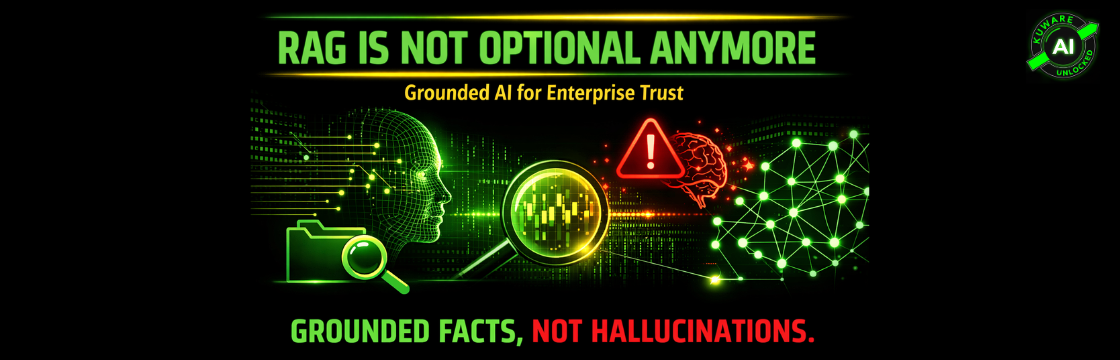
Why Grounded AI Is the New Standard for Enterprise Trust
By 2026, if you’re still deploying black box generative AI without retrieval grounding, you’re not being innovative. You’re being reckless.
I’m going to say that plainly.
For a while, we all tolerated hallucinations. We treated them like quirks. “Oh, the model made something up.” Cute. Interesting. Research-y.
But in production systems? In healthcare? Legal research? Enterprise decision workflows?
That’s not a quirk. That’s liability.
The real issue is this: large language models are probabilistic engines. They predict tokens. They do not inherently verify truth. When they operate purely from internal weights, they are guessing based on patterns learned from broad, shallow training data.
That works for drafting emails.
It does not work for mission-critical intelligence.
So the industry had to evolve. And Retrieval Augmented Generation, or RAG, became the architectural pivot point.
The Factual Integrity Crisis Nobody Talks About
Let’s be honest. The fundamental weakness of LLMs in professional domains comes down to three uncomfortable realities.
First, parametric limits. A model’s knowledge is frozen in its weights. It does not know what changed yesterday. It does not know your private documentation. It cannot see proprietary policy updates. You are asking it to operate blind.
Second, reasoning complexity. Specialized domains require multi-step logic across technical constraints. Regulatory compliance. Drug interactions. Precedent chains. LLMs can sound fluent while internally stitching together inconsistent reasoning. That is how hallucinations hide.
Third, context-sensitive jargon. Every industry has language that shifts meaning depending on situation. A generic model often flattens nuance. And flattened nuance is where subtle but dangerous mistakes live.
People tried to solve this with fine tuning. I did too. But here’s the problem.
Supervised fine tuning rewrites the weights. That means new knowledge can overwrite old capabilities. Catastrophic forgetting becomes real. And retraining is expensive. GPU heavy. Slow.
Many teams assume fine-tuning solves hallucinations, but the distinction between training, fine-tuning, and runtime retrieval is far more important than most realize.
Worse, it is opaque. You cannot trace a response back to a source document. It lives buried in parameters.
That’s not how you build enterprise trust.
RAG changed the game because it separates knowledge from reasoning. Instead of baking everything into the model, you retrieve external documents in real time and force the model to answer based on them.
Dynamic. Updateable. Auditable.
And honestly, much cheaper to maintain.
The RAG Triad That Actually Eliminates Hallucinations
At Kuware, we don’t treat RAG like a buzzword. We treat it like a diagnostic pipeline. And the only way it works in production is if you evaluate it rigorously.
There are three pillars I insist on measuring.
Context Relevance.
Are the retrieved documents actually relevant to the user’s question? If your retriever pulls noisy or loosely related content, the generator will weave that noise into the answer. That’s how subtle hallucinations creep in.
Are the retrieved documents actually relevant to the user’s question? If your retriever pulls noisy or loosely related content, the generator will weave that noise into the answer. That’s how subtle hallucinations creep in.
Groundedness.
Does every claim in the final answer trace back to retrieved evidence? Models love to expand beyond the context. They “fill in” gaps from training data. That expansion must be detected and penalized. We often use an LLM-as-judge approach or natural language inference models to break answers into claims and verify each against source context.
Does every claim in the final answer trace back to retrieved evidence? Models love to expand beyond the context. They “fill in” gaps from training data. That expansion must be detected and penalized. We often use an LLM-as-judge approach or natural language inference models to break answers into claims and verify each against source context.
Answer Relevance.
Even if the response is fully grounded, did it answer the actual question? A perfectly cited but irrelevant answer is still a failure.
Even if the response is fully grounded, did it answer the actual question? A perfectly cited but irrelevant answer is still a failure.
When all three pass, you have something powerful. Not just a response. A traceable, defensible asset.
That is the difference between experimental AI and enterprise AI.
Vector RAG Versus GraphRAG: Architecture Shapes Intelligence
Not all RAG systems are equal.
The simplest implementation uses vector search. You chunk documents, embed them, and retrieve based on semantic similarity. It scales well. It is fast. It works beautifully for customer support or knowledge base lookup.
But it has limits.
Vector similarity works at the surface level. It retrieves what looks similar. It does not understand deeper entity relationships.
That’s where GraphRAG enters.
GraphRAG introduces structured nodes and edges. Entities. Relationships. Hierarchies. It allows multi-hop reasoning.
Let me explain that in plain terms.
If Concept A connects to Concept B, and B connects to C, and C connects to D, a vector search might miss the A to D relationship if they are semantically distant. A graph traversal can follow the path.
That “k hop” traversal is what enables complex reasoning chains.
Medical drug interactions. Legal statute relationships. Cross domain dependency mapping.
But here’s the tradeoff. Graphs add complexity. They introduce scaling bottlenecks. Traversing dense graphs increases latency. You must design carefully.
Vector systems are simpler but susceptible to embedding drift. As your documents evolve, your vector representations grow stale. Re indexing becomes necessary.
There is no magic architecture. There is only fit for purpose.
Self Reflective RAG and the Rise of the Critic Model
Static pipelines are not enough anymore.
The next evolution is Self RAG. Systems where the model decides when retrieval is necessary. And even more interesting, systems where the model critiques its own output.
This introduces two roles.
The Generator produces the answer.
The Critic evaluates quality, groundedness, and utility.
The Critic evaluates quality, groundedness, and utility.
Reflection tokens allow structured control. Does the model need to retrieve? Is the passage relevant? Is the generated claim supported? Is the answer useful?
One subtle but crucial safety mechanism here is retrieved token masking during reinforcement learning. If you let the model memorize retrieved passages during training, you corrupt the inference logic. It must learn how to reason with retrieval, not memorize specific documents.
That distinction matters.
Because production systems need controllable inference, not clever shortcuts.
System 1 Versus System 2 in RAG Architectures
I often describe RAG systems using dual process theory.
System 1 RAG is fast and modular. Predefined routes. Hybrid search. Iterative refinement loops. Tree based summarization pipelines like hierarchical abstraction systems.
These are deterministic and predictable.
System 2 RAG is agentic. The model becomes a decision maker. It uses strategies like ReAct style reasoning, search retries, and reward driven correction. It can recognize failed retrieval and try again.
But here’s where many implementations go wrong.
If you reward retries blindly, you create infinite loops. Proper reward retry frameworks only grant positive signals when retrieval correction leads to successful task completion.
And then there’s honesty.
Truly advanced agentic systems are trained to decline when information is missing. That sounds simple. It’s not. Models default to answering. Teaching them to say “I do not know” reliably is one of the hardest safety behaviors to engineer.
But in enterprise settings, it is non negotiable.
What 2026 Enterprise AI Actually Requires
By 2026, RAG is not experimental. It is default architecture for production intelligence.
If you are deploying AI into operations, this is the implementation discipline I recommend.
First, validate the use case. If your domain requires frequent updates or traceable citations, RAG is mandatory.
Second, clean your corpus. Remove redundant and noisy documents. Garbage in still equals garbage out.
Third, use domain tuned embeddings and hybrid search. Combining semantic vector retrieval with keyword matching is now standard practice.
Fourth, design prompts that force citation and constrain extrapolation.
Fifth, monitor metrics that matter. Retrieval precision. Recall. Hallucination rate. Not vanity metrics.
Sixth, implement governance. Role based access control for retrieval. PII redaction. Context window management to prevent the lost in the middle problem where models ignore central information.
And finally, iterate. Department by department. Measure impact before scaling.
Industry Specific Grounding Is Where RAG Shines
In medicine, GraphRAG can surface rare comorbidity patterns across disparate records.
In legal research, explainable graph paths allow attorneys to trace reasoning across statutes and precedents.
In customer support, vector RAG enables rapid recall of manuals and ticket histories without retraining the core model.
These are not theoretical examples. These are production realities.
RAG Is Not Just a Technical Pattern. It Is a Strategic Capability.
Here’s what most executives miss.
RAG centralizes enterprise intelligence. It creates a single, governed knowledge substrate that AI systems reason over.
That changes how decisions are made.
Instead of black box outputs, you get traceable intelligence. Instead of hallucination risk, you get grounded reasoning. Instead of static weights, you get dynamic knowledge.
This is the difference between renting intelligence and owning it.
And that matters.
Because in the next few years, companies will not compete on whether they use AI. Everyone will.
They will compete on whether their AI is trustworthy.
Grounded. Auditable. Controlled.
RAG is the foundation for that future.
And if you are building enterprise AI without it, you are building on sand.
If you want help architecting grounded AI systems for your organization, this is exactly the kind of implementation discipline we build at Kuware.
Unlock your future with AI. Or risk being locked out.
