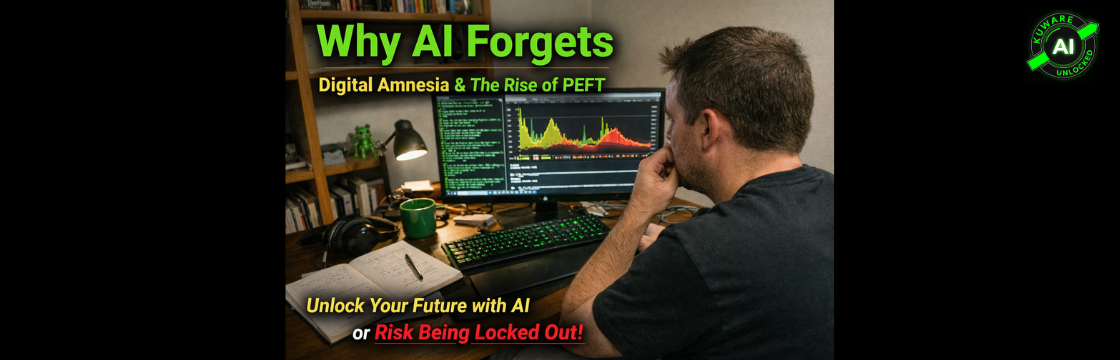
The Hidden Mechanics of Digital Amnesia and the Rise of PEFT
I’ve always found this ironic.
We build Large Language Models that can reason across law, biology, poetry, and quantum mechanics. They can debate philosophy, generate production code, and explain tensor calculus to a beginner. Yet the moment you fine-tune them on something new, they start forgetting what they already knew.
Not gradually. Not gracefully.
They overwrite themselves.
This phenomenon is called catastrophic forgetting. I call it digital amnesia. And if you are deploying AI in production, it is not a curiosity. It is a risk.
Understanding when to fine-tune at all is critical, especially if you have not yet evaluated whether retrieval might solve your business problem more safely and efficiently.
Let me explain what is actually happening under the hood, because once you see it clearly, the solution becomes obvious.
The Similarity Paradox Nobody Expects
Here’s the first counterintuitive truth.
The more similar your new task is to your old one, the worse the forgetting.
Yes, really.
Research shows that task similarity correlates strongly with forgetting severity, with a Pearson correlation of r = 0.87. That number is not subtle.
You would think that similar tasks reinforce each other. Instead, they collide.
Why?
Gradient conflict.
When the new task is semantically close to the old one, the model tries to reuse the exact same neural circuits. Same Query projections. Same Key matrices. Same attention heads. Instead of allocating new representational space, it aggressively overwrites the existing one.
It is like renovating a house by tearing down load-bearing walls.
The damage is structural.
The Three Gears of Forgetting Inside a Transformer
When we analyze transformers using tools like Centered Kernel Alignment and Hessian eigenvalue analysis, three mechanisms show up consistently.
And once you see them, you cannot unsee them.
1. Attention Mechanism Disruption
The earliest disruption happens in the lower layers.
Typically layers 1 through 8, sometimes through 12.
Between 15 percent and 23 percent of attention heads reorganize dramatically during fine-tuning. The worst gradient conflict shows up in Query and Key projection matrices, around 67 percent conflict rates. Value projections are more stable at roughly 34 percent.
Here’s the wild part.
Some of these disrupted heads are not even essential for the new task. Studies show that ablating the 20 percent most disrupted heads can restore nearly half of the lost performance on original tasks.
That tells you something important.
Forgetting is often noise, not necessity.
2. Representational Drift
Move up into the intermediate layers, roughly 12 to 24, and you see structural drift.
Centered Kernel Alignment scores drop by 0.32 to 0.47 after sequential fine-tuning. The leading principal components rotate as much as 52 degrees.
In plain English, the model’s internal geometry shifts.
Even trillion-parameter models are not immune. Larger models experience less direct gradient interference because they have more representational degrees of freedom. But they still suffer comparable drift.
Scale helps. It does not solve the problem.
3. Loss Landscape Flattening
This is the part most people ignore.
And it is the most dangerous.
Originally, task knowledge sits in sharp minima in the loss landscape. These sharp regions act like restoring forces. If you perturb the model slightly, it snaps back.
After sequential updates, those sharp minima flatten.
Hessian eigenvalues that once peaked around 147.3 can drop to 34.2. When that happens, the restoring force disappears. Knowledge becomes diffuse. Irrecoverable.
Here’s the critical insight.
Flattening often happens one to two epochs before accuracy visibly drops.
Which means we can detect amnesia before it becomes obvious.
That is not just interesting. That is operationally powerful.
The Timeline of Forgetting
If you track training carefully, the pattern is predictable.
Epochs 1 to 2
Attention disruption begins. Query and Key conflict spikes. Performance impact is small.
Attention disruption begins. Query and Key conflict spikes. Performance impact is small.
Epochs 3 to 5
Representational drift accelerates. Now accuracy drops.
Representational drift accelerates. Now accuracy drops.
Epoch 4 and beyond
Loss landscape flattening dominates. At this stage, recovery becomes unlikely.
Loss landscape flattening dominates. At this stage, recovery becomes unlikely.
If you are deploying AI in regulated environments or mission-critical systems, this timeline matters. You can build early warning diagnostics instead of reacting after degradation.
Why Full Fine-Tuning Is Reckless in Production
Let me be blunt.
Full-model fine-tuning in a business environment is often reckless.
You are updating every weight in the network. You are increasing entropy in attention heads by 1.8 to 2.4 bits. You are destabilizing a model that took millions of GPU hours to train.
And for what?
To adapt it to a narrow use case.
This is where Parameter-Efficient Fine-Tuning, or PEFT, changes everything.
PEFT Is Not a Hack. It Is Engineering Discipline.
Think of full fine-tuning as rebuilding an entire car just to drive on ice.
PEFT is swapping the tires.
Instead of updating 100 percent of parameters, you update 1 to 10 percent. You freeze the base model. You preserve its general intelligence.
The benefits are not marginal.
Compute savings up to 90 percent.
Far less risk of overfitting.
Few-shot data requirements instead of millions of labeled examples.
Far less risk of overfitting.
Few-shot data requirements instead of millions of labeled examples.
And most importantly, dramatically reduced catastrophic forgetting.
This is not just efficiency. It is architectural hygiene.
In regulated environments, many teams now combine PEFT with enterprise RAG pipelines that keep knowledge external and auditable.
LoRA and QLoRA: The Intelligence Multiplier
The most successful PEFT implementation today is LoRA, Low Rank Adaptation, and its quantized cousin QLoRA.
The idea is elegant.
Instead of modifying the full weight matrices, you approximate updates using low-rank decompositions. Tiny matrices. Minimal parameters. Maximum leverage.
Research shows that LoRA can approximate full fine-tuning performance while using over 95 percent fewer trainable parameters.
That is not incremental. That is transformational.
For edge devices, this is a breakthrough. QLoRA allows high-intelligence models to run on constrained hardware. Mobile phones. IoT sensors. Local AI systems.
This aligns perfectly with our philosophy at Kuware.
AI you own. Not AI you rent.
Beyond Language: The Universal Engine Idea
Here is where it gets even more interesting.
Using techniques like Language-Interfaced Fine-Tuning, we can adapt LLMs to handle non-language data. Vision tasks. Tabular datasets. Structured data.
In some experiments, LLM-based systems outperform specialized architectures like TabNet on certain OpenML datasets.
That means we are not just building chatbots.
We are building universal reasoning engines.
And with PEFT, they can specialize without erasing their core intelligence.
Guardrails Are Not Optional
None of this eliminates responsibility.
Efficient fine-tuning can amplify bias in base layers. Data drift can quietly degrade performance. Over-automation can lead to catastrophic decisions in healthcare or legal contexts.
So what do we do?
We build architectural guardrails.
Active learning pipelines to handle data drift.
Explainability dashboards to audit internal pathways.
Human-in-the-Loop oversight for high-stakes decisions.
Compliance baked into the tuning pipeline from day one.
Explainability dashboards to audit internal pathways.
Human-in-the-Loop oversight for high-stakes decisions.
Compliance baked into the tuning pipeline from day one.
AI is not autonomous wisdom. It is structured probability.
Treat it accordingly.
The Bigger Question
Can we build AI that accumulates knowledge over time without deleting its past?
Biological intelligence does this. Humans layer experience. We refine models of the world without erasing childhood memory every time we learn a new skill.
Transformers were not originally built for continual learning.
But with mechanistic interpretability and PEFT, we are getting closer.
If we can detect loss landscape flattening early. If we can isolate gradient conflict zones. If we can adapt surgically instead of destructively.
Then we stop building models that overwrite themselves.
And we start building systems that grow.
That is the frontier.
And if you are building AI inside your business, the choice is simple.
Unlock your future with AI
Or risk being locked out.
Or risk being locked out.
Make the choice now.
