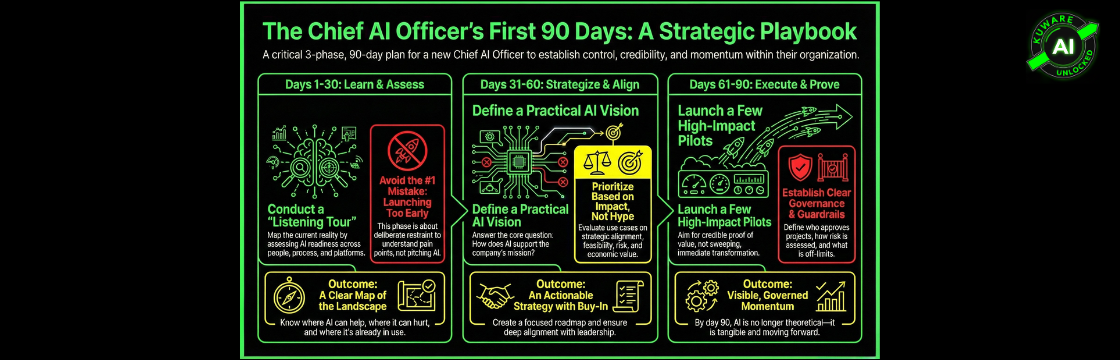
A Chief AI Officer’s (CAIO) first 90 days are typically structured around a “playbook” approach derived from Michael D. Watkins’ framework for leadership transitions. The goal during this period is to move from assessment to strategic planning and finally to early execution.
While this playbook focuses on execution, it is equally important to understand how the Chief AI Officer role differs from the CIO and CDO, especially when responsibilities around data, infrastructure, and AI strategy begin to overlap.
Here is a breakdown of what a CAIO does during their first 90 days, divided into three distinct phases.
Phase 1: Learning and Assessment (Days 1–30)
The first month is dedicated to auditing the organization’s current state to determine its “AI readiness.” This involves deep analysis rather than immediate action.
- Organizational Readiness Evaluation: The CAIO assesses the workforce’s AI literacy, confidence, and adaptability. This includes determining if employees view AI as an opportunity or a threat and evaluating the leadership’s commitment levels.
- Business Context Analysis: The CAIO analyzes the industry’s competitive dynamics, identifying where competitors are already deploying AI and where customer expectations are evolving.
- Infrastructure and Technology Audit: They review existing technology capabilities, data infrastructure, and limitations to understand the technical feasibility of potential AI initiatives.
- Listening Tour: A critical component is engaging with stakeholders to understand business challenges and existing cultural resistance. This helps in mapping current capabilities and constraints.
Phase 2: Strategic Design and Planning (Days 31–60)
In the second month, the CAIO shifts to synthesizing their findings into a coherent strategy. This phase focuses on alignment and prioritization.
- Vision Definition: The CAIO articulates a clear vision for how AI supports the organization’s core mission and long-term objectives. This includes defining specific, measurable objectives and risk tolerance levels.
- Use Case Prioritization: Using frameworks to evaluate potential projects, the CAIO identifies high-impact opportunities. A recommended tool is the SCALE Framework, which evaluates use cases based on:
- Strategic Alignment
- Competitive Advantage
- Achievability
- Learning Value
- Economic Impact
- Investment Strategy: The CAIO develops a plan for necessary investments in technology platforms, talent acquisition, and vendor partnerships.
- Relationship Building: They continue to build alliances across departments (IT, Legal, HR, Operations) to ensure the eventual strategy will not be siloed.
Phase 3: Execution and Implementation Planning (Days 61–90)
The final phase of the first 90 days involves operationalizing the strategy and launching initial initiatives.
- Roadmap Development: The CAIO creates a phased implementation plan with clear milestones, resource allocations, and contingency strategies.
- Governance and Risk Frameworks: They establish the decision-making structures regarding AI ethics, compliance, and risk management. This includes defining who has the authority to approve AI initiatives. This emphasis on governance reflects the broader mandate of the role, as outlined in the Chief AI Officer’s responsibility for strategy, governance, and ethical leadership across the enterprise.
- Organizational Design: This may involve redefining roles, updating skill requirements, and structuring teams to support the new AI agenda.
- Communication Strategy: The CAIO launches a broader communication plan to reinforce the AI vision to the wider organization, sharing success stories and soliciting feedback to manage the cultural change.
- Pilot Execution: By the end of this period, the CAIO typically moves to launch pilot projects or “quick wins” to demonstrate value and adjust strategies based on early feedback.
Decision-Making Frameworks
Throughout this 90-day period, successful CAIOs often utilize the IMPACT Framework to guide their decisions:
- Identify business problems.
- Map capabilities.
- Prioritize based on strategy.
- Assess risks and resources.
- Commit to objectives.
- Track progress.
Note on Government Mandates: It is worth noting that for US federal agencies, the timeline for establishing AI leadership was even more aggressive. The Office of Management and Budget (OMB) mandated that agencies appoint a CAIO within 60 days of its March 2024 memorandum.
